How to Build a Real Estate Website in 2025: DIY Builders vs. WordPress vs. Custom Dev
Here’s a stat that should make every agent without a website nervous: 96% of buyers used the internet during their home search in 2024. And 43% of them started by searching online, before ever calling an agent, according to NAR’s 2024 Profile of Home Buyers and Sellers. Your website isn’t a digital business card. It’s where your pipeline begins.
The problem? When you try to build a real estate website, you immediately face three very different paths: cheap DIY builders that launch in an hour, WordPress with a specialized real estate theme, or a fully custom build from a development agency. Each path has real trade-offs in cost, control, and capability. And most agents pick the wrong one because they optimize for “fastest to launch” rather than “best for lead generation.”
This guide walks through all three approaches with verified costs, a feature-by-feature comparison table, and a clear recommendation for each type of real estate professional. You’ll also get the IDX integration breakdown that most guides skip entirely. By the end, you’ll know which real estate website builder fits your situation, and why this decision matters far more than most agents realize.
What Your Real Estate Website Actually Needs to Do
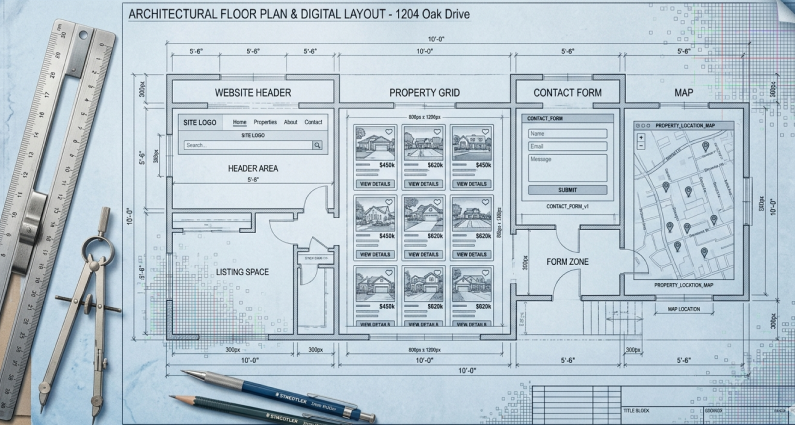
A real estate agent website has one job: turn property searches into qualified leads. Every feature decision should serve that goal. Before comparing platforms, you need to know what “good” looks like.
- Live MLS/IDX listings: IDX (Internet Data Exchange) is the data feed that pulls live MLS listings directly into your website, updated every 15 to 30 minutes. Without it, your site is a static brochure while Zillow shows buyers what’s actually for sale.
- Advanced property search with filters: Price, beds, baths, location, property type. Buyers expect this. If they can’t filter, they’ll leave.
- Mobile-responsive design: 76% of real estate website traffic comes from mobile devices (SEO Sandwitch, 2025). And according to BrodNeil’s 2025 analysis, as many as 85% of users may abandon sites that aren’t optimized for mobile. If your property pages don’t load cleanly on a phone, you’re losing most of your visitors.
- Lead capture and contact forms: The average real estate website converts at just 0.4% to 1.2%, based on industry figures compiled by ReSimpli from NAR 2024 data. At those rates, every page on your site needs to push toward a form fill.
- CRM integration: Leads are only valuable if someone follows up. A website-to-CRM workflow isn’t optional for agents with any real traffic volume.
- Agent and agency profiles: Each agent needs their own page with a contact form, listings tab, and bio. Brokerages need this for every team member.
- Interactive map search: Buyers search by neighborhood, not by street address. A map-based property search keeps visitors engaged and on your site.
- Mortgage calculator: Reduces buyer friction and keeps them browsing longer instead of bouncing to a bank’s website.
- Blog and content section: Neighborhood guides, market updates, and buyer tips drive organic search traffic over time.
- Virtual tour embedding: Properties with 3D tours sell up to 31% faster and at up to 9% higher prices (per Matterport’s own published data, 2024). Your site needs to support them natively.
Not all platforms handle these features equally, especially IDX. That distinction separates a real property listing website from a generic business site with some photos of houses.
Option 1: DIY Website Builders (Wix, Squarespace)
Let’s give DIY builders a fair look — they solve a real problem for a specific type of agent.
Wix and Squarespace are powerful general-purpose tools. Drag-and-drop editing, AI website generation (Wix ADI can build a draft site from a questionnaire), professional templates, built-in hosting, domain registration, and SSL. You can go from nothing to a live website in under an hour. No technical skills required.
Pricing: Wix Core plan runs about $23/month. Squarespace Business plan is in the same range. But forget the “free” plans. Free means no custom domain, platform branding on every page, and zero professional credibility. Not viable for a real estate agent website.
So what’s the catch?
The IDX Problem
This is where DIY builders hit a wall for real estate specifically. Wix has no native IDX/MLS integration (check their own support page). The workaround is iHomefinder via the Wix App Market, but it uses an iframe embed. Here’s why that matters: Google cannot crawl iframed content. Every property listing that comes through the IDX feed is invisible to search engines on your domain. You accumulate zero property-level SEO value. You’re building Zillow’s index, not yours.
As Laura Perez of MLSImport.com puts it: “Wix offers an efficient, all-in-one solution for agents looking to get online fast with minimal technical involvement.” That efficiency advantage is real. The permanent trade-off: your listings will never rank in Google.
SEO Reality Check
Wix now supports meta titles, descriptions, XML sitemaps, and structured data. For a bakery or a consulting firm, Wix SEO is fine. For real estate, the IDX indexation gap is a fundamental handicap that no amount of on-page optimization can fix. You can write the best blog posts in the world, but if your 500 property listings are invisible to Google, you’re leaving serious organic traffic on the table.
Platform Lock-in
What happens if you stop paying? You lose the site. All your content, your template customizations, your uploaded images. There’s no export button that moves your Wix site to another host. You’re renting, not owning.
Who Should Use a DIY Builder
Solo agents in their first year who need something live this week. Agents whose leads come from referrals and social media, not organic search. Anyone who wants an online presence right now while planning a longer-term solution. If that’s you, a DIY builder is a reasonable start. If IDX and organic lead generation are priorities, it’s not.
Option 2: WordPress + a Real Estate Theme
WordPress powers 43.6% of all websites globally and 61.4% of all CMS-based websites (W3Techs via Elegant Themes, 2025; WPBeginner CMS Market Share Report). That market share isn’t a vanity number. It translates directly into ecosystem advantages: more developers available for hire, more plugins, more IDX integrations, and more documentation when you get stuck.
Why WordPress Wins on SEO
WordPress gives you full control over URLs, meta titles, descriptions, canonical tags, schema markup, and site speed optimization. Plugins like Yoast SEO and Rank Math — both of which generate XML sitemaps and property listing schema automatically — provide granular on-page control that DIY builders simply can’t match. But the real SEO advantage is this: IDX listings can be imported as native WordPress posts, fully indexable, on your own domain. Every new listing becomes a new page that Google can find and rank.
The Ownership Argument
With WordPress on your own hosting, you own 100% of your data, leads, and content. No platform can change pricing, deprecate features, or shut your site down. On portal sites like Zillow, your leads are shared with competing agents. On your own WordPress site, every form fill belongs to you.
Total Cost of Ownership
Here’s what Year 1 actually costs for a WordPress real estate website:
- Hosting: $10 to $50/month (shared) or $28+/month (managed cloud)
- Domain: about $15/year
- WordPress theme (WPResidence): $49 a year
- IDX subscription (MLSImport): about $49/month ($588/year)
- Optional plugins: $100 to $300/year
Self-managed Year 1 total: roughly $1,200 to $2,500. If you hire a developer for setup and customization, expect $3,000 to $10,000 total first year. Compare that to a DIY builder at $23/month plus $49/month for an iframe-based IDX add-on: $864/year. Similar or even lower Year 1 cost, but with a permanent SEO limitation baked in.
As Laura Perez of MLSImport.com explains: “WordPress provides unmatched flexibility and depth, ideal for growing teams that require advanced customization, integrations, and multi-MLS capabilities.”
The Honest Trade-off
WordPress requires more setup than Wix. Choosing a host, installing WordPress, configuring a theme, and setting up IDX is a 1 to 3 day process for a non-technical user following documentation. Or a 1 to 2 week freelancer project. That’s a real trade-off. But it’s a one-time cost, not a permanent limitation.
WordPress is the right choice for agents who want organic search leads, agents building a long-term brand, brokerages managing multiple agents, and anyone who needs full IDX integration with SEO value. And the theme you choose determines how much of that potential you actually unlock.
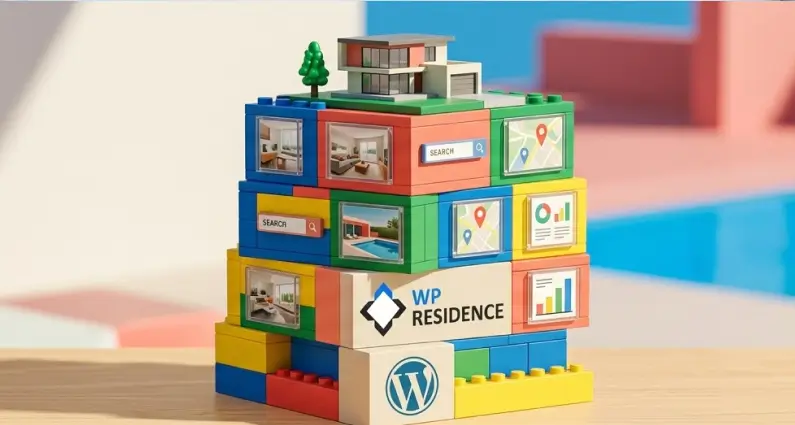
Why WPResidence Is the Best WordPress Theme for Real Estate
Proven Track Record
The real estate WordPress theme WPResidence has been on the market for over 10 years, with 31,000+ buyers and 1,600+ five-star reviews on ThemeForest. It ships with 50 ready-to-use demo sites and 450+ configuration options. The price is $49 a year for one site, with a year of theme updates and support; the site keeps working if you do not renew.
Native IDX/MLS Integration via MLSImport
This is the most important technical differentiator. WPResidence integrates natively with MLSImport, connecting to 800+ RESO-compliant MLS boards across the US and Canada. Unlike iframe-based IDX on Wix, listings imported through MLSImport become native WordPress posts. Each listing gets its own indexable URL on your primary domain. Google can crawl and index every single one. Sync happens every hour, keeping listing data current throughout the day.
Pricing: MLSImport offers a 30-day free trial, then about $49/month. Other IDX providers (iHomefinder, Showcase IDX, IDX Broker) also work with WPResidence via shortcodes, but native-import IDX delivers the best SEO outcome.
One important caveat: the WPResidence theme itself doesn’t include any MLS feed. IDX is a separate subscription, and most MLS boards also require their own data agreement and may charge a monthly compliance fee. Budget for three cost layers: theme, IDX provider, and MLS board.
Advanced Search, Maps, and Property Pages
WPResidence includes multi-parameter AJAX-powered search filters (price, beds, baths, city, ZIP, custom fields) with no page reloads. Header-map and half-map page templates let buyers browse listings visually. Property pins show listing previews on hover. Both Google Maps and OpenStreetMap are supported. And everything works with both manually entered listings and MLSImport MLS data.
Agent and Agency Management
Four user types are supported: agents, agencies, developers, and regular users. Each gets dedicated profile pages with AJAX-filtered listing tabs. Agents submit listings from a front-end dashboard — a form with fields for price, beds, baths, photos, and description — with no WordPress admin access required. That last part matters for brokerages: your agents can manage their listings without touching the backend.
Built-in CRM and HubSpot Integration
Every form submission on a WPResidence site gets saved as a lead with contact info, source property, and creation date. Role-based visibility means admins see all leads, agents see their own. Lead statuses: New, Contacted, Closed.
For teams using HubSpot: WPResidence describes itself as the only WordPress real estate theme to offer complete HubSpot integration, with a direct API key connection and real-time sync. Per-user HubSpot keys are supported (each agent connects their own account). Webhooks support Zapier connections to Salesforce, Follow Up Boss, and ActiveCampaign.
Mortgage Calculator, Virtual Tours, and Elementor Compatibility
A built-in mortgage calculator widget comes included. Full Elementor compatibility means pages can be built and customized without touching code. Virtual tours from Matterport or YouTube embed natively into property pages.
As Adrian Remys, the WPResidence developer, puts it: “For most small to mid-sized real estate agencies, WordPress solutions offer the most practical balance of cost and capability.”
Option 3: Custom Real Estate Website Development
Custom development means a design agency or freelance team builds your site from scratch. Custom design, custom codebase, custom functionality. No off-the-shelf theme.
Cost Reality
Here’s what that actually costs, according to WPResidence’s cost analysis and Qrolic’s 2025 breakdown:
- Startup-level custom site (under 15 pages): $25,000 to $30,000
- Mid-size agency site: $50,000 to $60,000
- Large-scale platform (franchise, multi-market): $100,000+
Agency hourly rates run $100 to $300/hour. Freelancers charge $50 to $100/hour. Timeline? Three to five months for a basic custom site. Six to nine months or more for complex builds. During that time, you have no web presence.
The Ownership Advantage
You own the codebase outright. No recurring theme fees, no platform lock-in, complete design freedom. As Jason Fox, a real estate agent and website coach, argues: building your broker’s brand or Zillow’s brand rather than your own is the biggest risk of third-party platforms. Custom development eliminates all dependency on external platforms.
The Developer Dependency Risk
Here’s the part most agencies don’t mention in the sales pitch. Custom code creates a specialized dependency. Bug fixes, security patches, and new features require developers who know that specific codebase. WordPress has a global developer marketplace of millions. Your custom site does not. Expect $100 to $250/hour for ongoing maintenance, billed irregularly and unpredictably.
Who Custom Development Is Right For
Large brokerages with unique workflow requirements. Franchise networks that need white-label multi-site deployments. Proptech startups building a platform product, not just a website. Established luxury agencies where design differentiation justifies the investment.
As Adrian Remys notes: “Many successful real estate companies in 2025 are choosing hybrid approaches, starting with WordPress and selectively implementing custom components for strategic competitive advantage while maintaining cost efficiency.”
For individual agents and small agencies, the ROI on custom development doesn’t close at any reasonable timeline.
Platform Comparison: Build a Real Estate Website That Matches Your Goals
Side-by-Side Comparison Table
| DIY Builder (Wix/Squarespace) | WordPress + WPResidence | Custom Development | |
|---|---|---|---|
| Upfront cost | $0 (theme/design) | $49 a year (theme) | $25,000–$100,000+ |
| Monthly cost | $23+/month | $50–$100/month (hosting + IDX) | $100–$250/hr maintenance |
| Year 1 total | ~$276 without IDX; ~$860–$900 with IDX add-on | ~$1,200–$2,500 (self-managed) | $25,000–$100,000+ |
| Time to launch | Under 1 hour | Days to weeks | 3–9 months |
| IDX/MLS support | Limited (iframe only) | Full native import | Full (custom built) |
| SEO control | Moderate | Full | Full |
| Data ownership | Platform owns | You own | You own |
| Ease of use | Very easy | Moderate | N/A (developer-managed) |
| Scalability | Low | High | Highest |
| CRM integration | Basic | Native HubSpot + Webhooks | Custom |
| Best for | New agents, brochure sites | Agents, brokerages, serious growth | Enterprise, franchise, proptech |
Which Platform Should You Choose?
If you need to be online tomorrow and your leads come from referrals and social media, a DIY builder is acceptable. It gets you a professional-looking site fast.
If organic search leads, IDX integration, and owning your data matter to you, WordPress + WPResidence is the right choice for most agents and brokerages. It’s the middle path that doesn’t sacrifice the features you’ll need as you grow.
If you run a franchise network or you’re building a proptech product with unique technical requirements, custom development is worth the investment.
Whatever platform you choose, the next section covers the feature that separates real estate websites from everything else: IDX.
How IDX Integration Works, and Why It Determines Your SEO Ceiling
IDX (Internet Data Exchange) is the system that allows real estate agents to display live MLS listings on their own website. The MLS board pushes a continuous data feed to an IDX provider, and the provider syncs it to your site, typically every 15 to 30 minutes. Without IDX, your real estate website can’t show buyers what’s actually for sale in your market.
Here’s what most agents don’t know: there are three types of IDX integration, and the type you use determines whether your listings help your Google rankings or not.
The Three Integration Types
1. iFrame embed. The IDX provider’s listing pages load inside a frame on your website. Fast to set up. But Google treats iframed content as belonging to the IDX provider’s domain, not yours. Every listing page is invisible to search engines on your domain. Result: zero SEO value from hundreds of listings.
2. Subdomain redirect. Listings live on a separate subdomain (e.g., listings.youragency.com). Better than iframes since the domain is yours, but Google treats subdomains as separate sites — ranking signals for the subdomain don’t benefit the main domain’s authority as effectively as primary-domain content would.
3. Native post import. Listings are imported as native WordPress posts on your primary domain (e.g., youragency.com/listings/123-main-street). Google indexes each one. Every new listing becomes a new indexable page. Over time, an agent with 500+ active and sold listings accumulates 500+ indexed pages — a compounding SEO advantage. This is how WPResidence + MLSImport works.
What IDX Access Actually Requires
Three layers most agents don’t anticipate:
- MLS board membership and a data agreement (most boards charge a monthly compliance fee)
- An IDX provider subscription (about $49 to $85/month depending on provider)
- A compatible website platform that supports the IDX provider
IDX Provider Quick Comparison
- MLSImport: ~$49/month, 800+ MLS boards, native WordPress import (best for SEO)
- Showcase IDX: ~$74.95/month, strong search UI, native WordPress import
- iHomefinder Premium: ~$85.50/month, works with Wix (iframe) and WordPress (iframe or API)
The SEO Compounding Effect
Real estate agent Bret Wallace grew his gross commission income from $175,000 to $224,000 in his first year after building a WordPress site with proper IDX and SEO, and to $320,000 by year two — a 10:1 ROI, according to an inboundREM case study. The mechanism is straightforward: native IDX creates hundreds of indexable listing pages. Each page captures long-tail search traffic (“3 bedroom homes in [neighborhood]”). Over months, the site becomes an organic lead machine. No DIY builder with iframe IDX can replicate this.
How to Build a Real Estate Website: Your Step-by-Step Path
Here are the six steps to build a real estate website on WordPress:
- Choose your platform
- Register a domain
- Set up hosting
- Install WPResidence and configure your theme
- Set up IDX integration
- Add lead capture and launch
Step 1: Choose Your Platform
Refer back to the comparison table above. If organic leads and IDX matter to you, WordPress. If you need to be live today with zero setup, a DIY builder. This guide focuses on the WordPress path from here.
Step 2: Register a Domain
You’ve got two schools of thought. An agent-name domain (janedoerealty.com) builds personal brand. A city+keyword domain (austinhomesearch.com) signals local relevance to Google. For local SEO, the second option has a slight edge. NAR members can also register a .realtor TLD for professional credibility. Keep it short, memorable, and skip the hyphens.
Step 3: Set Up Hosting
WordPress requires a hosting account (unlike Wix, hosting isn’t bundled). Managed WordPress hosting from providers like WP Engine, Kinsta, or SiteGround offers better performance and security. Cost: $10 to $50/month for shared hosting, or $28+/month for managed cloud. An SSL certificate (HTTPS) is non-negotiable, both for security and because Google uses it as a ranking signal.
Step 4: Install WPResidence and Configure Your Theme
Install WordPress through your host’s one-click installer. Upload and activate WPResidence. Pick one of the 50 demo sites, then import the demo content using the One-Click Demo Install plugin — the import takes approximately 5 to 10 minutes. You’ve got a working skeleton. The 450+ options panel lets you configure everything without code. Elementor handles further page customization. Set up your main pages: property listings, advanced search, agent profiles, contact, and blog. Time estimate: 1 to 3 days for a non-technical user following documentation.
Step 5: Set Up IDX Integration
This is the step most guides skip entirely. First, confirm your MLS board membership and apply for IDX data access. Timelines vary by board, from 48 hours to 2 weeks. Next, sign up for MLSImport (30-day free trial). Connect MLSImport to WPResidence using the plugin and API key. Configure your import settings, sync your listings, and verify they appear on the site as native posts with their own URLs.
Step 6: Add Lead Capture and Launch
Connect your CRM (HubSpot natively, or through Zapier to Follow Up Boss, Salesforce, or ActiveCampaign). Configure lead notification emails. Set up Google Analytics and Google Search Console. Submit your sitemap. Write your first blog post (a neighborhood guide is ideal for kickstarting local SEO). Publish.
Real Estate SEO: How to Rank Against Zillow and Realtor.com
Let’s be blunt about the challenge. You aren’t competing with the agent down the street for “homes for sale in [city].” You’re competing with Zillow, Realtor.com, and Redfin, all of which have thousands of indexed pages and domain authority scores in the 80s and 90s. Direct competition for head terms is unwinnable. So don’t try.
Long-Tail Keyword Strategy
Zillow covers every city. It does not own “3 bedroom homes under $400k in Westlake Hills” or “homes with pools near Anderson Mill Elementary.” These hyper-specific terms are where a local agent with a well-built WordPress site can rank in months, not years. And they convert better because the search intent is more specific.
Neighborhood Guide Pages
Building dedicated pages for each neighborhood you serve — covering market stats, school ratings, commute times, and local amenities — is the most reliable local SEO strategy for real estate. Each page targets neighborhood-specific search queries. They’re evergreen and compound over time. One catch: this strategy requires native-import IDX so you can embed indexable listings directly in the neighborhood page.
Google Business Profile
An optimized Google Business Profile is the fastest path to appearing in local map pack results for “[city] real estate agent” queries. It works alongside your website SEO, not as a replacement.
Technical SEO for Real Estate
Real estate sites are notoriously slow because of high-resolution property photos. Core Web Vitals (Largest Contentful Paint, Interaction to Next Paint, Cumulative Layout Shift) are Google ranking factors. The fixes: image compression (WebP format), lazy loading, a CDN, and managed WordPress hosting with caching. WPResidence is built for performance, but image optimization is still the site owner’s responsibility.
Internal Linking
Link property listings to neighborhood guides. Link neighborhood guides back to the main search page. Link blog posts to relevant listing pages. This internal linking structure passes authority to your most valuable pages and helps Google understand your site’s hierarchy.
How much can this move the needle? A Netrocket case study documented a WordPress real estate site that saw +67% organic traffic and +44% conversion rate improvement in just 3 months after targeted SEO work. That kind of gain is only possible on a platform where you control the technical SEO levers. No DIY builder gives you that control.
Here’s where this all comes together. You’ve seen the cost data, the feature comparison, and the IDX breakdown. The choice comes down to who you are and what you need right now.
If you’re a new agent who just needs a web presence fast and your leads come from referrals, a DIY builder is a reasonable start. No shame in it.
If you’re an agent or brokerage that wants organic search leads, full IDX integration, and long-term ownership of your data and leads, WordPress + WPResidence is the clear choice for most of the people reading this. It’s the best balance of cost, capability, and control.
If you run an enterprise brokerage, franchise network, or proptech company with unique technical requirements, custom development is justified.
The agents who build the right foundation now — indexed IDX listings, local SEO content, owned lead data — create a compounding advantage that gets harder to catch every month. A real estate website built on the right platform today is worth more in five years than one started “correctly” two years from now. When you build a real estate website with that long-term view, the platform decision isn’t a cost. It’s an investment.
FAQ
What features should a real estate website include to actually generate leads (not just look good)?
A real estate website should be built to convert property searches into qualified leads. At minimum, that means live MLS/IDX listings (so buyers see current inventory), an advanced search with filters (price, beds, baths, location, property type), mobile-responsive pages, and strong lead capture on every key page (contact forms tied to listings and agent pages).
For agents and brokerages with meaningful traffic, CRM integration is also essential so leads are followed up reliably. Other high-impact features covered in this guide include agent and agency profile pages with listing tabs, interactive map search, a mortgage calculator to reduce buyer friction, a blog/content area for long-term SEO, and support for virtual tour embeds so property pages keep visitors engaged.
Why is IDX integration so important, and what kind of IDX setup is best for SEO?
IDX is what allows your website to display live MLS listings that stay current throughout the day. Without IDX, your site becomes a static brochure while portal sites show the real inventory, which undercuts both user experience and lead generation.
For SEO, the integration method matters. iFrame embeds are fast to set up, but listing content loaded in an iframe typically is not crawlable on your domain, so you get little to no property-level SEO benefit. A subdomain approach is better than iframes, but Google often treats subdomains more like separate sites, so the SEO benefit may not flow to your main domain as strongly. The strongest approach for organic growth is native post import, where each listing becomes a native page on your primary domain with its own indexable URL that Google can crawl and rank.
When is a DIY builder like Wix or Squarespace a reasonable choice for a real estate website?
A DIY builder can be a reasonable starting point when you need a site live immediately and your business is not relying on organic search for leads. The guide’s best-fit examples include solo agents in their first year, agents getting leads primarily from referrals and social media, and anyone who needs a professional online presence this week while planning a longer-term platform.
The key limitation to understand is IDX. Wix does not offer native IDX/MLS integration, and common workarounds can rely on iframe-based listing displays, which prevents your property listings from building SEO value on your domain. If you want listings that can rank in Google over time, the guide recommends choosing a platform that supports indexable, native-import IDX.
What does a WordPress real estate website cost in year 1, and how does that compare to DIY and custom development?
For WordPress, the guide estimates a self-managed year-1 total of roughly $1,200-$2,500, driven by hosting ($10-$50/month shared or $28+/month managed cloud), a domain (about $15/year), a theme license ($49 a year), an IDX subscription (about $49/month), and optional plugins ($100-$300/year). If you hire a developer for setup and customization, the guide notes a typical first-year range of $3,000-$10,000.
By comparison, a DIY builder plan is around $23/month, and adding an iframe-based IDX add-on brings the guide’s estimated annual total to roughly $860-$900, but with the long-term SEO limitation of non-indexable listings. For a fully custom build, the guide cites startup-level pricing around $25,000-$30,000, mid-size agency sites around $50,000-$60, and large-scale platforms at $100,000+, with timelines measured in months.
How does WPResidence support IDX, CRM, and agent/team workflows on WordPress?
WPResidence is positioned in the guide as a WordPress theme built specifically for real estate sites that need IDX, lead capture, and multi-agent management. For IDX, it integrates natively with MLSImport, which supports 800+ RESO-compliant MLS boards across the US and Canada. With native import, listings come into WordPress as posts on your primary domain, giving each property its own indexable URL, and the guide notes hourly syncing to keep data current.
On the operations side, WPResidence includes agent and agency profile pages, a front-end dashboard for agents to submit listings without needing WordPress admin access, and built-in lead handling where form submissions are saved with contact details, source property, and a creation date. The guide also describes native HubSpot integration (API key connection and real-time sync), support for per-user HubSpot keys, and webhooks that can connect through Zapier to tools like Salesforce, Follow Up Boss, and ActiveCampaign.