
By Chris Bean, real estate web strategy, WPResidence. Chris has spent the last decade building and advising on WordPress real estate websites, with hands-on experience in IDX integration, theme architecture, and agent lead-generation workflows across North America, Europe, and Australia.
Last updated: April 2026.
Every single home buyer who closed on a house last year started online. Not most, not “a vast majority”, 100%, according to the NAR 2025 Profile of Home Buyers and Sellers. And 43% of them say their very first step was to look for properties online, before they talked to a lender, picked a neighborhood, or called an agent.
So why do most real estate agent websites still fail to capture a single lead in a quarter?
That is the gap this guide is going to close. Whether you practice in Dallas, Dublin, or Dubbo, the strategic question is the same even if the technical setup differs. This article covers what websites for real estate agents actually need, how to choose a platform, what it costs, and how to make the thing generate leads — written for both agents making the decision and WordPress developers building the site. Done right, the best websites for real estate agents pay for themselves in a single closed deal.
What Is a Real Estate Agent Website?
A real estate agent website is a dedicated, agent-controlled web presence, separate from any brokerage site or property portal, that showcases the agent’s listings, biography, and local expertise while capturing visitor contact information as leads. Unlike a Zillow profile or brokerage page, the agent owns the domain and keeps it regardless of which firm they work for.
That distinction matters more than it sounds. A brokerage profile is a thin page on someone else’s domain. A Zillow or Rightmove listing puts you next to thousands of other agents on a portal you do not control. Social media is algorithm-dependent, with no lead capture and no SEO benefit for your name. Your brokerage website disappears when you move firms. Your own domain stays with you.
Why Websites for Real Estate Agents Are Essential in 2026
The data does not leave much room for debate. The NAR 2025 Profile, authored by Dr. Jessica Lautz, reports that 100% of home buyers used the internet to search for a home during the survey period (July 2024 to June 2025). 43% of those buyers named online property search as their first step. And 88% of buyers still worked with a real estate agent or broker, while 91% of sellers did the same and FSBO fell to a historic low of 5%.
Read that again: buyers go online, then hire an agent. Your website is the handshake between those two behaviors.
As Dr. Lautz put it: “Buyers want a real estate agent or broker who is not only able to help them find the right home but is also going to help them negotiate, explain, and understand the real estate market.” If your website cannot demonstrate you are that person before the first call, a competitor’s will.
A brokerage profile page cannot do this job. It gives you no SEO benefit, no control over the copy, no separate lead capture, and it disappears the day you move firms. Among all websites for real estate agents, the ones built on your own domain are the most durable business assets — among the few that appreciate in SEO value over time.
Now, the international picture. In portal-dominant markets, agents list on the big portals but build their own sites for brand, social proof, and non-portal lead capture. Rightmove drew 98.7 million visits in June 2023 in the UK. In Australia, realestate.com.au attracted 13.05 million unique visitors in October 2025, over 60% of the country’s adult online population. Agents still need websites for real estate business development in those markets; the sites just play a different role than they do in North America.
One honest reality check before we go further: the industry-average conversion rate for real estate websites is around 2%, with top portals like Zillow exceeding 5%. Expect most visitors to leave without converting. The goal of this guide is to help you beat that average.
Must-Have Features of a Real Estate Agent Website
- IDX or property search. A live, searchable listing feed. In the US and Canada this means IDX; outside North America it means manually managed listings or a portal-fed feed. The single most-used feature on agent websites.
- Lead capture forms. Short, low-friction forms at multiple touchpoints: property pages, home valuation widget, contact page. Keep it to name, email, phone. Every extra field kills conversion.
- Agent bio and personal branding. Professional headshot, credentials, license number (required in most jurisdictions), and a narrative that answers “why work with me.”
- Client testimonials. Social proof from past buyers and sellers. Video testimonials add credibility, especially in luxury segments.
- Neighborhood guides and local content. Hyperlocal pages covering schools, commute times, local amenities, and market trends. Builds SEO authority and positions the agent as a true local expert, not a name on a sign.
- Home valuation tool. An automated valuation widget that turns curious homeowners into named seller leads. One of the highest-converting CTAs on agent sites.
- Mobile-responsive design. Over 50% of real estate website traffic is mobile. A site that is not mobile-first loses more than half its audience.
- Professional photography and video. Photos drive 41% of buyer satisfaction with listing content (NAR 2025). Cinematic video elevates brand perception for luxury agents.
- Fast page speed (Core Web Vitals). LCP under 2.5 seconds. Property-image-heavy pages are a performance risk. Images are the LCP element on 85% of desktop pages per the 2025 Web Almanac.
- Saved searches and listing alerts. Keeps buyers returning and captures email. The primary middle-of-funnel tool.
- Contact CTAs on every page. Not just a contact page: a sticky header CTA, an in-property-page contact form, a “Request a showing” button.
- SSL certificate and custom domain. Baseline trust and SEO requirement.
These twelve features apply to all effective websites for real estate agents, though priority shifts by market. IDX is table stakes in the US and Canada and almost irrelevant in the UK and Australia, where portal feeds do that job. Priority also shifts by agent type. A new solo agent needs lead capture above all; a luxury agent prioritizes brand photography and video testimonials; a team broker needs CRM integration and saved-search automation. Pick from this list, do not try to ship all twelve at launch.
How Websites for Real Estate Agents Are Built: Four Approaches
When agents and developers ask which real estate website builder to pick, the honest answer is “it depends on four tradeoffs”: cost, control, speed to launch, and technical comfort. The four platform categories below each optimize for a different mix of those four. Choosing correctly is the single most important early decision for any agent building their first website.
SaaS Real Estate Builders
SaaS builders are the most common all-in-one solution for websites for real estate agents who need speed over flexibility. You sign up, pick a template, plug in your MLS credentials, and a week later you have a site with IDX, CRM, and automation bundled. The main players, with 2026 pricing:
- Placester: $79 to $319/month (NAR member pricing).
- Real Geeks: ~$299/month on the Establish plan, plus a $250 setup fee.
- Sierra Interactive: $500 to $1,500/month.
- Luxury Presence: $500+/month, built for luxury brands.
- AgentFire: $129/month Spark Site, no setup fee (runs on WordPress under the hood).
- kvCORE / BoldTrail: $499 to $1,800/month, usually for teams.
- BoomTown: $1,000/month Launch plan plus $750 setup, for larger brokerages.
Jaycie Mariotti, Director of Marketing at Sierra Interactive, frames the category well: “Your IDX website isn’t just a tool, it’s the foundation of your digital presence. When thoughtfully designed, it becomes a lead engine, a marketing platform and a trust builder all in one.” That is the sales pitch, and for the right user it is accurate.
Pros: fast setup (days, not weeks), IDX and CRM bundled, vendor-managed hosting and maintenance, templates already optimized for real estate UX.
Cons: ongoing monthly cost that never goes away, vendor lock-in (your leads, content, and SEO equity live on their infrastructure), limited customization beyond their templates, and if you cancel, the site goes away with the subscription.
Best for: agents who want a site live within a week with zero technical involvement, teams needing a bundled CRM plus IDX plus automation stack, and agents whose hourly value is worth more than the subscription fee.
WordPress + a Real Estate Theme
For agents and developers who want full ownership and long-term SEO control, building on self-hosted WordPress with a purpose-built real estate WordPress theme is the most flexible path. You get your own domain, your own database, real HTML pages Google can index, and no monthly fee to a platform vendor. The tradeoff is that you (or a developer) have to set it up and keep it updated.
The WordPress approach has three parts: WordPress itself (free), a real estate theme (typically a one-time fee of $59 to $75), and, for US/Canada agents, an IDX plugin that pulls in MLS listings. Three themes dominate the market: WPResidence, Houzez, and RealHomes. Since this article runs on the WPResidence blog, full disclosure: WPResidence is the house pick. Here is why, with the tradeoffs attached so you can judge for yourself.
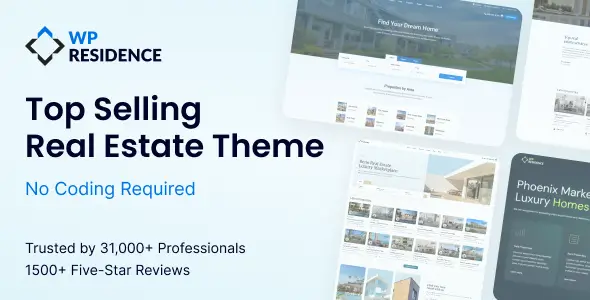
WPResidence. 32,000+ sales and 1,500+ five-star reviews on ThemeForest, making it one of the top-rated real estate themes since its 2013 launch. The feature list that actually matters: 50 one-click demo imports (so a developer can match a client’s aesthetic without designing from scratch), 450+ theme options, WPResidence Studio (an Elementor-based design system for custom templates), a built-in WpEstate CRM, HubSpot CRM API integration, advanced Ajax property search with radius and draw-on-map tools, 3D virtual tour embeds on listing pages, front-end property submission, WPML and Weglot multilingual support, PHP 8.3 compatibility, and a genuinely active update cadence (two releases in December 2025 alone).
On IDX specifically, WPResidence integrates natively with the MLSImport plugin, which connects to 800+ RESO-compliant MLS boards in the US and Canada. Listings are imported directly into the WordPress database, not iframed from a vendor’s server. That means each listing page is a real, fully indexable page on your domain, which is the single biggest long-term SEO advantage WordPress has over SaaS. It also plays nicely with iHomefinder, IDX Broker, dsIDXpress, and Showcase IDX if your MLS board prefers a different vendor. You can see it running live at demo3.wpresidence.net, orlando.wpresidence.net, and oakland.wpresidence.net, all real WPResidence plus MLSImport builds.
The third-party endorsement is worth citing. MLSImport (a separate plugin vendor, not WPResidence) rates WPResidence as its top recommendation: “WPResidence, with its proven track record of success in multiple MLS-driven projects, is a reliable choice for professionals.” Christina Catalano, a broker at makeaustinhome.info, on the same site: “The MLSImport team was absolutely amazing in working with me to install and set up the plugin, give me tips about creating the import searches, and trouble shoot any issues I had.” Real agents, not marketing fluff.
Who WPResidence is right for: WordPress developers and agencies, solo agents or small teams in the US/Canada wanting native MLS integration, and international agents (UK, EU, Australia) who need a professional listing and lead-capture site without MLS at all.
This profile covers the majority of developers and agents who turn to WordPress for websites for real estate agents. Who should look elsewhere: agents who want the site live in 48 hours with zero technical involvement (a SaaS builder is faster), agents who need a fully managed CRM plus calling plus automation stack in one bundled product (kvCORE or BoomTown fit better despite the higher cost), and agents with no developer access and no comfort managing hosting, plugins, or updates. The WordPress learning curve is real. Do not pretend otherwise.
Houzez (~$75 one-time) has 54,171 ThemeForest sales and a 4.84 rating per MLSImport’s comparison. Strong built-in CRM and membership/agency features; aimed more at portal-style sites than solo agents. RealHomes (~$59 one-time) is beginner-friendly, includes a vacation-rental module, and has a clean aesthetic. All three themes work with MLSImport and IDX Broker, and all three still require you to budget $39 to $150+/month for the IDX plugin on top of the one-time theme cost.
General Website Builders: Wix and Squarespace

Wix ($16 to $45/month) and Squarespace ($23 to $65/month) power websites for real estate agents in portal-dominant markets who need brand presence without IDX, or for US agents on very small budgets who are not ready to commit to a full IDX setup. Beautiful templates, no developer needed, lowest cost, fastest launch.
The catch: neither has a native real estate IDX. Third-party embed workarounds exist, but they are iframed, invisible to Google, and clunky on mobile. Customization hits a ceiling fast, and neither is built for property-search UX. Best for UK, EU, and Australian agents where portals handle listing distribution, or for new US agents testing brand presence before committing to IDX.
Custom Builds
A custom-coded real estate site starts around $25,000 to $30,000 for a startup-level build, with most agency-grade sites landing between $20,000 and $45,000, plus $50 to $200/month in maintenance. These are for large brokerages, franchise groups, luxury brands, and teams with proprietary workflow requirements (custom MLS pipelines, internal CRMs, bespoke valuation models).
For a solo agent or small team, a custom build is overkill when evaluating websites for real estate agents. A well-configured WPResidence or SaaS platform delivers 90%+ of the same functionality at 10% of the cost. Custom is justified at scale, not by ego.
Platform Comparison at a Glance
The table below lets agents and developers compare websites for real estate agents across the four main platform categories. All pricing is stated as of 2026 — verify current figures with each vendor before committing.
| Platform | Monthly Cost (2026) | IDX Support | Control / Ownership | Speed to Launch | Ongoing Maintenance | Best For |
|---|---|---|---|---|---|---|
| SaaS builders (Placester, Real Geeks, Sierra, Luxury Presence) | $79 to $1,500+ | Bundled, seamless | Low: vendor-owned infrastructure | Days | Vendor-managed | Agents wanting all-in-one speed |
| WordPress + real estate theme (WPResidence, Houzez) | $10 to $30 hosting + $39 to $150 IDX plugin | Via plugin (MLSImport, IDX Broker, etc.) | High: full ownership, portable | 1 to 4 weeks | Agent or developer | Developers, agents wanting SEO control |
| General builders (Wix, Squarespace) | $16 to $65 | None native; limited embed workarounds | Medium: template constraints | Days | Minimal | Non-IDX markets (UK, AU, EU); basic brand presence |
| Custom build | $1,500 to $4,000/mo equiv. ($20k to $45k+ upfront) | Custom-built | Maximum | 3 to 6 months | Developer retainer | Large brokerages, luxury brands |
Two caveats on the table. When evaluating websites for real estate agents, IDX relevance depends entirely on market: it is essential in the US and Canada, largely irrelevant in Europe and Australia. And the “right” platform is driven by your technical comfort, your budget, and how much control you want over your brand and your lead data. There is no single winner for all use cases.
IDX and MLS Integration Explained
Half the agents researching websites for real estate agents do not actually know what IDX is — only that every platform seems to mention it. Fair enough. The acronyms are ugly. Here is the whole thing in plain English.
MLS (Multiple Listing Service) is a private database run by a local Realtor association or board in the US or Canada. There is no single national MLS; boards serve specific geographic regions. Agents pay membership dues and agree to rules about how listings can be shared. Your local MLS is where listings are born.
IDX (Internet Data Exchange) is both a policy framework (governed by most North American MLSs under NAR oversight) and a technology system that lets member agents display MLS listings on their own websites. You sign a participation agreement and use an approved IDX vendor to feed MLS data into your site.
The technical implementation is where developers need to pay attention. Modern IDX runs on the RESO Web API, the successor to the older RETS standard. You have two integration models to pick between, and this choice determines whether the agent gets any long-term SEO benefit from the MLS data.
- Native import. Listing data is pulled into the agent’s own WordPress database, creating real HTML pages on the agent’s domain. Google indexes them. Over 12 to 24 months, the listing library becomes a real organic search moat. This is what MLSImport plus WPResidence gives you.
- Iframe or widget. Listings are served from the IDX vendor’s servers and embedded on the agent’s site. Faster to set up. Worse for SEO: Google cannot index iframed content. You are renting listings on your own site.
For a US or Canada WordPress build, native import is almost always the correct architectural choice. The only time iframe wins is when the MLS board explicitly requires a specific vendor widget.
Cost-wise, basic IDX plugins run $39 to $79/month for individual agents; advanced systems with CRM reach $300+/month. Most agents settle around $80 to $150/month all-in for a solid setup. MLS board data-access fees add another $0 to $33/month on top.
One compliance note that gets almost no coverage: MLS listing photos are typically owned by the original listing agent or photographer, not the displaying agent. IDX participation agreements define what you can and cannot do with them, and MLS boards set rules on watermarking, attribution, and how long you can display sold listings. Read your participation agreement before you assume you can use every photo forever.
The most important thing to understand about websites for real estate agents outside North America: MLS does not exist. This catches a lot of developers off guard when they take on their first international client. UK agents list on Rightmove, Zoopla, and OnTheMarket via subscription feeds (XML, REAXML, or proprietary formats). Australian agents list on realestate.com.au (13.05 million unique visitors in October 2025) and Domain. EU markets are fragmented across national portals: Idealista in Spain, Seloger in France, ImmoScout24 in Germany. In every one of these markets, the agent website handles branding, content marketing, and lead capture, not listing distribution. A Wix, Squarespace, or WPResidence site without an IDX plugin works perfectly well. If your client is in Manchester, do not try to sell them IDX. You will look silly.
Lead Generation Patterns That Work
A website that looks pretty but captures nothing is a business-card expense, not a marketing asset. The strongest websites for real estate agents generate leads through a deliberate three-stage funnel, broken into a three-stage funnel.
Top of funnel. Neighborhood guides, market reports, IDX search. These attract and engage. Someone types “Brooklyn Heights schools” into Google; they land on your neighborhood page; they start browsing listings; they stick around.
Middle of funnel. Saved searches, listing alerts, home valuation tools. These capture contact information. This is where you trade value (a valuation, a daily alert) for an email address. The home valuation tool is the highest-converting CTA for seller leads because sellers want to know their number. Joyce Rey’s site at joycereygroup.com is a textbook example: a persistent home-valuation icon follows the visitor on every page, so no high-intent moment is missed.
Neighborhood guides are the other middle-of-funnel workhorse. Hyperlocal content (school ratings, commute time, local business recommendations, quarterly market reports) ranks in Google long after the listings expire. WPResidence supports custom neighborhood pages that combine editorial content with filtered property grids on the same page, a strong SEO and conversion pairing. Gated saved searches work the same way: require a free registration to save a search, and alert emails pull people back to your site for months.
Bottom of funnel. Contact form, “Request a showing” button, live chat or AI chatbot. These are hot leads.
Here is the uncomfortable part. Capturing the lead is only half the job. The other half is speed.
Agents who respond within 5 minutes are 21x more likely to convert a lead than those who wait 30 minutes. The average agent takes 917 minutes (over 15 hours) to respond. And 78% of buyers work with the first agent who responds, a widely cited industry figure worth keeping honest about: it is a practitioner benchmark, not peer-reviewed research.
This reframes lead-capture form design as a notification-engineering problem. When someone fills out your contact form, the form must trigger an immediate SMS to the agent’s phone, an email, and a CRM push, all three, not just a “we’ll be in touch” thank-you page. In practice, this means your contact form should SMS your phone the moment it’s submitted. If it does not, every lead your beautiful website captures is leaking out the back.
AI chatbots are the emerging answer here. Platforms like kvCORE and Real Geeks have integrated AI qualification tools that engage a lead within seconds, ask qualifying questions, and schedule showings. Not universal yet, but worth tracking.
Design, UX, and Performance Principles
Realtor website design has converged on a few non-negotiable principles, and mobile-first sits at the top of the list. It is structural, not optional. Over 50% of real estate website traffic is mobile, and on luxury listings the number often runs higher. Design must start with mobile: touch-friendly filters, clear tap targets, no hover-only interactions. Test load speed on a mid-range Android, not just your MacBook. “Responsive” and “mobile-optimized” are not the same thing.
For developers, the single most important performance metric on a property-heavy site is LCP (Largest Contentful Paint). Target LCP under 2.5 seconds. Property pages are LCP traps because they are stacked with high-resolution photos competing to be the largest element. According to the 2025 Web Almanac, images are the LCP element on 85% of desktop pages and 76% of mobile pages. Translation: on a real estate site, your hero listing photo is almost certainly your LCP, and if it is slow, everything is slow.
The fixes are specific and boring: serve images in WebP or AVIF format, not JPEG; avoid lazy-loading the hero or LCP image (set loading="eager" and fetchpriority="high" on that one image); defer non-critical JavaScript; host images on a CDN. Audit with Google PageSpeed Insights before handing the site to the client.
Schema markup is the other technical lift that pays off. Implement RealEstateAgent schema on the agent bio and contact pages, RealEstateListing on each property page (automatable via plugin when using native import), and LocalBusiness on the homepage. Reported industry data suggests schema-enhanced listings see a 15 to 30% increase in organic CTR; treat that as a single-source range, not gospel, but the upside is real.
Photography and media drive the rest of the UX story. NAR 2025 data shows photos drive 41% of buyer satisfaction with listing content. Industry estimates suggest 46% of real estate professionals now use 3D or virtual tours, and the reported range on tour-equipped listings is that they sell 20 to 30% faster. Accessibility matters too: WCAG 2.1 AA alt text on every listing image, keyboard-navigable search filters, and sufficient color contrast are requirements both for legal compliance (ADA in the US, EN 301 549 in the EU) and for SEO, because alt text is indexed content.
Compliance Essentials for Real Estate Agent Websites
United States
Websites for real estate agents in the US must meet a specific set of regulatory requirements. The Equal Housing Opportunity logo is standard practice in the footer, though the rule is more nuanced than most articles claim. The Greater Albuquerque Association of Realtors’ myth-vs-fact piece makes clear that NAR’s 2024 guidance did not mandate the logo on every marketing material, but HUD still looks unfavorably on advertising without a Fair Housing signal. Most states require agents to display their license number and brokerage affiliation; rules vary by state, so check your own regulator. NAR’s Standard of Practice 12-5 requires REALTORS to disclose their firm name in any advertising medium, which of course includes the website. On MLS photos: the original listing agent or photographer typically owns the image; your IDX participation agreement defines what you can display and for how long.
EU and UK
GDPR (EU) and UK GDPR + PECR apply to any form on your website that processes personal data of EU or UK residents. Requirements: granular cookie consent (opt-in, not opt-out), a lawful basis for processing, a privacy notice, and the ability to withdraw. Google Analytics, Facebook Pixel, and any remarketing cookie need prior explicit consent, per the UK ICO’s PECR guidance. Under the UK’s Estate Agent Act, agents must also disclose their agency relationship on the website itself.
Australia and Other Markets
The Australian Privacy Act 1988 requires a privacy policy on all websites for real estate agents that collect personal data via a lead form. Each Australian state and territory has its own licensing regime, and the agent’s license number or trading name must appear on all advertising, including the website. Consult REIA or your state REI body. The general rule everywhere: before you launch, check your local real estate regulator’s website-advertising rules. Saying “I didn’t know” is not a defense.
Real-World Examples of Excellent Agent Websites
The strongest websites for real estate agents share a quality that has nothing to do with aesthetics: every design decision is in service of a specific business outcome. These three examples illustrate that principle across different platform types.
Joyce Rey: Consistent Lead Capture on Every Page
Site: joycereygroup.com. Platform: AgentImage custom build. The design is minimalist, white, grey and gold, nothing fighting for attention. Testimonials sit front-and-center, which is exactly right for luxury buyers. The home valuation CTA is visible on every page via a persistent icon, so no high-intent visitor moment is missed. A “Video of the Week” format positions Joyce as a thought leader and drives return visits. Lesson for agents: lead-capture placement is a design decision, not an afterthought.
Josh Flagg: Cinematic Video and Expanded IDX Search
Site: joshflagg.com. Platform: Luxury Presence. The homepage opens with cinematic video of Los Angeles luxury properties, which sells the city and the lifestyle before it sells the agent. The IDX search is expanded: visitors can browse all LA luxury listings, not just Flagg’s active inventory, which increases time on site and builds brand association. Lesson for developers: expanded search (showing the market, not just your listings) is a lead-generation strategy. People return for the search, stay for the agent.
Tori Thompson: Simplicity as Strategy
Site: tori-thompson.com (via WebdesignatNY real estate website examples roundup). Platform: Custom build. A full-screen video banner, ample white space, clean typography. Fewer features than most agent sites, but every element has a job. No visual clutter competing with the listings. Lesson: more features do not equal more leads. Among all websites for real estate agents, the fastest and cleanest often outperform feature-heavy alternatives with poor UX.
WPResidence in Action
For a developer-level look at native MLS integration, the live demos at demo3.wpresidence.net, orlando.wpresidence.net, and oakland.wpresidence.net run WPResidence with the MLSImport feed. Every listing page lives on the agent’s own domain (not a vendor subdomain), which makes it fully indexable by Google. MLSImport cites these as reference implementations for agents and developers comparing the native-import approach to iframed alternatives.
For WordPress Developers: Building a Real Estate Site for an Agent Client
This section is aimed at WordPress developers and agencies building websites for real estate agents. Readers who do not care about implementation specifics can skip to the cost breakdown below.
Theme Selection Criteria
When you shortlist a real estate theme for websites for real estate agents, evaluate on five dimensions: MLS board compatibility (does the IDX plugin for that theme support the client’s specific MLS?), demo aesthetic quality (client onboarding is dramatically faster when a demo already matches their vision), update cadence (check the changelog: WPResidence had two updates in December 2025, which is a good health signal), PHP 8.x compatibility, and Elementor or block-editor support for client self-management after launch. Shortlist to themes with 10,000+ verified ThemeForest sales so you have confidence the vendor will still be shipping updates in two years.
IDX Plugin Selection and Integration
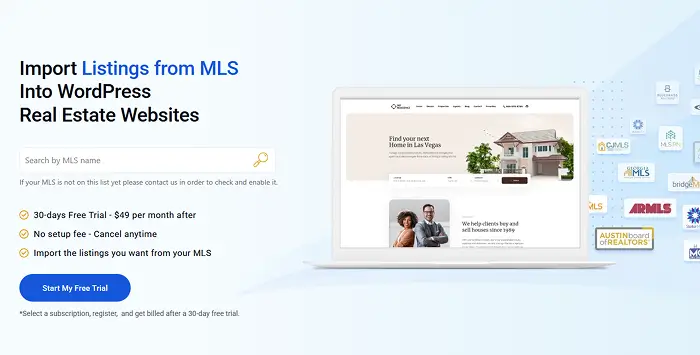
For US and Canada clients, MLSImport is the cleanest option: native RESO Web API import, 800+ MLS boards, data lives in the WordPress database, which means real HTML pages Google can index. Alternatives: IDX Broker, iHomefinder, Showcase IDX. The two decision criteria are (1) does the plugin do native import or iframe, and (2) is the client’s specific MLS board supported? Always ask for the MLS board name before quoting.
For non-US clients, skip IDX entirely. Use WPResidence’s built-in property management for manual listing management, or set up a CSV/XML import workflow if the client has a large inventory. The website handles brand, lead capture, and content marketing; portal listings (Rightmove, realestate.com.au, Idealista) are managed separately through the agent’s portal subscription.
Budget $39 to $150+/month for the IDX plugin in US builds and include it in every proposal — it is the line item most commonly missed when quoting websites for real estate agents. The number-one client surprise at handoff is the IDX plugin bill nobody mentioned.
Schema Markup Implementation
Implement RealEstateAgent on the bio/about page, RealEstateListing on each property page (automatable when using native import; WPResidence handles this), LocalBusiness on the homepage, and FAQPage on any FAQ section. Verify every type with Google’s Rich Results Test before handoff. Reference schema.org/RealEstateAgent and schema.org/RealEstateListing for the required properties.
Core Web Vitals Optimization for Listing Pages
Property pages are LCP traps. Identify the hero image (the first visible above-the-fold listing photo), set loading="eager" and fetchpriority="high" on that one image, serve it in WebP, and push all images through a CDN. Defer all non-critical JS. Target LCP under 2.5 seconds on a mid-range mobile device, not just desktop. Audit with PageSpeed Insights before handing over.
Client Handover Checklist
- Set up a limited Editor or Agent user role so the client cannot accidentally break the theme.
- Record a Loom walkthrough of adding and editing a listing (10 minutes, do it once, send it forever).
- Document IDX plugin management: who to contact at MLSImport or IDX Broker for MLS issues.
- Enable automatic plugin updates for WPResidence and the IDX plugin (Envato Auto-Updates or ManageWP).
- Document hosting, admin credentials, and DNS setup in a secure handoff doc (1Password vault, not a Google Doc).
What Do Websites for Real Estate Agents Cost in 2026?
| Tier | Upfront Cost | Monthly Ongoing | Notes |
|---|---|---|---|
| DIY builders (Wix, Squarespace) | $0 | $16 to $65 | No IDX; design templates; fastest to launch |
| SaaS real estate platforms | $0 to $750 setup | $79 to $1,500+ | IDX + CRM bundled; all-in pricing |
| WordPress (self-managed) | $69 theme + $12 to $20/yr domain | $10 to $30 hosting + $39 to $150 IDX | One-time theme; ongoing IDX subscription |
| WordPress (developer-built) | $2,500 to $8,000 dev fee + theme | $10 to $30 hosting + $39 to $150 IDX | Best long-term SEO value; needs developer |
| Custom build | $20,000 to $45,000+ | $50 to $200 maintenance | Maximum flexibility; for large teams |
There is a hidden cost nobody quotes in most comparisons of websites for real estate agents. An agent spending 40 to 60 hours setting up a DIY website has spent real money. At an effective hourly value of $100+/hour, that is $4,000 to $6,000 in opportunity cost, which is more than a developer-built WordPress site would have cost upfront. The “cheap” builder is often the expensive one once you account for time. This is not a scare tactic; it is honest ROI math.
The other quiet cost is the IDX plugin. US and Canada agents on WordPress add $39 to $150/month in perpetuity, and that line item rarely shows up in “WordPress is cheaper than SaaS” comparisons. Budget for it before you commit.
All pricing here is “as of 2026.” Verify current numbers directly with each vendor before you quote a client or sign a contract.
Common Mistakes Real Estate Agents Make With Their Websites
These are the seven patterns that consistently hold back websites for real estate agents from generating the leads they were built to capture.
- Relying on the brokerage website. Your leads, your SEO, and your brand equity all live on someone else’s domain. When you switch firms, all of it evaporates. Cost of this mistake: every lead you captured in the last three years.
- Choosing a builder with no IDX in US/Canada markets. A site without property search forces visitors to go to Zillow. You pay for hosting and get zero leads from your own platform. Cost: the entire reason you built the site.
- Using iframed IDX instead of native import. All those listing pages are invisible to Google. You are paying $100/month for IDX and getting zero long-term SEO benefit. Cost: two years of compounding organic search authority.
- Ignoring mobile performance. Over 50% of traffic is mobile. A site that loads slowly on a mid-range Android loses half the audience before the first listing renders. Cost: half your traffic.
- Slow lead response after capture. Agents responding within 5 minutes are 21x more likely to convert. If your website captures a lead and you respond 15 hours later, the form was pointless. Cost: 78% of the leads go to whoever answers first.
- Overbuilding features at the expense of speed. Too many plugins, heavy page builders, and unoptimized images tank Core Web Vitals and frustrate mobile visitors. Cost: search rankings and bounce rate.
- No compliance signals. Missing license number, no EHO footer (US), no GDPR consent (EU/UK). Cost: regulatory risk plus visitor trust you did not know you were losing.
FAQ: Frequently Asked Questions
Do real estate agents really need their own website?
Yes. 100% of buyers used the internet to search for a home in the NAR 2025 Profile. A brokerage profile page will not build your personal brand and disappears when you switch firms. An owned website is your most durable business asset. In portal-dominant markets outside North America, the role is branding and lead capture rather than listing distribution, but websites for real estate agents remain essential in every market.
What is IDX and do I need it?
IDX (Internet Data Exchange) lets agents display live MLS listings on their own websites via a participation agreement and an approved vendor. It is essential for US and Canada agents who want property search on their site. Outside North America, agents list on portals (Rightmove, realestate.com.au, Idealista) and do not use IDX; a site without it works fine in those markets.
How much does a real estate agent website cost?
Cost varies widely. DIY builders like Wix run $16 to $65/month. SaaS real estate platforms (Real Geeks, Sierra Interactive) run $79 to $1,500+/month. WordPress self-hosted starts around $10 to $30/month in hosting plus $39 to $150/month for the IDX plugin, with a one-time $59 to $75 theme cost. Custom builds run $20,000 to $45,000+. The right choice depends on technical comfort, budget, and how critical IDX is.
What is the best website platform for real estate agents?
It depends on the agent. SaaS platforms (Real Geeks, Sierra Interactive) are fastest to launch with IDX bundled. Among websites for real estate agents built on WordPress, WPResidence offers maximum control, full ownership, and long-term SEO via native MLS integration. Wix and Squarespace suit agents in non-IDX markets or those prioritizing simplicity. No single platform is universally best — match the platform to the agent’s goals, technical comfort, and geographic market.
Can I build my own real estate website without a developer?
Yes. DIY builders (Wix, Squarespace) and SaaS real estate platforms (Placester, AgentFire) are designed for non-technical agents. For WordPress, a non-technical agent can use a one-click demo theme like WPResidence, but will need basic comfort with hosting, plugins, and updates, or a one-time developer setup. The hidden cost is time: 40 to 60 hours of DIY setup has real opportunity cost for a practicing agent.
What is the difference between a real estate agent website and a Zillow profile?
A Zillow or Rightmove profile is a listing on a portal you do not own; you are one of thousands of agents on someone else’s platform, and the portal keeps the SEO equity and the lead data. A real estate agent website is your own domain, under your control, where every visitor and lead accrues to your brand and stays with you regardless of brokerage. Both can coexist; the profile supplements, not replaces, the owned site.
What should a real estate agent website include?
Well-built websites for real estate agents include, at minimum: IDX or property search (in North America), lead capture forms, agent bio with license number, client testimonials, neighborhood guides, a home valuation tool, mobile-responsive design, fast page speed (LCP under 2.5 seconds), saved-search and listing alerts, contact CTAs on every page, and a custom domain with SSL. See the features section above for the full checklist and prioritization logic by agent type.
The best websites for real estate agents have shifted from marketing nice-to-have to essential business infrastructure. The platform you pick matters less than getting the fundamentals right: lead capture that actually fires, IDX where relevant, speed on mobile, and a response loop that does not leave warm leads sitting for 15 hours. For US and Canada agents building on WordPress, native MLS integration is the architectural decision that pays the largest long-term SEO dividend, and it is the reason WPResidence plus MLSImport is the setup we recommend for developers and serious solo agents.
Pick the tier that matches your situation in the comparison table above, then ship. The average agent is 15 hours slow on lead follow-up; if your website and your notifications beat that by 14 hours and 55 minutes, you win.
About the author: Chris Bean leads real estate web strategy at WPResidence. He has worked on WordPress real estate builds across North America, the UK, and Australia, and writes about IDX integration, theme architecture, and agent lead-generation workflows.