12 Real Estate Agent Website Examples Worth Copying (2026)
Last updated: May 12, 2026
Are you looking for real estate agent website examples you can actually learn from, not just a screenshot gallery? We’ve broken down 12 live US agent and brokerage sites element by element: homepage hero, agent grid, search UX, and branding.
Most buyers begin online, and a large majority still buy through an agent (NAR 2024 Profile). Some patterns transfer to a smaller-budget site; others are luxury-specific. A handful have an element to avoid, flagged “Skip this.” Bookmark what every agent website needs before you brief a designer.
About this list: eight of the 12 sites run on Luxury Presence, three on AgentFire, one on a custom Agent Image build with kvCORE IDX. None of this is sponsored. WPResidence publishes this article and is our recommended WordPress alternative, flagged where it matters.
The 12 best estate agent websites at a glance
- SERHANT. (NYC) – multi-agent brokerage
- Carolwood Estates (Beverly Hills) – boutique brokerage
- Jade Mills Estates (Beverly Hills) – solo agent
- Kumara Wilcoxon (Austin, TX) – solo agent
- Ginger Martin + Co (Napa Valley) – solo agent
- Robin Kencel Team (Greenwich, CT) – solo/small team
- Carlin Wright (NYC) – solo agent
- Village Properties (Santa Barbara) – large brokerage
- Indigo Road Realty (Atlanta) – multi-agent team
- Living Telluride (Telluride, CO) – two-person team
- Oasis Realty Group (Sarasota, FL) – multi-agent team
- Path & Post Real Estate (N. Atlanta) – boutique brokerage
What makes a great real estate agent website?
A great real estate agent website does five things: lets buyers search live MLS listings, loads fast on a phone, shows your credentials up front, makes contacting you frictionless, and positions you as the local expert.
- IDX or MLS-first search. Without it, buyers have no reason to come back.
- Mobile lead capture. Sticky CTAs and click-to-call are must-haves. Buyers won’t hunt for your number on mobile.
- Neighborhood pages. They drive organic traffic and signal local authority.
- A home valuation lead magnet. The highest-converting seller capture tool in residential real estate.
- Social proof you can’t fake. Specific numbers (“$9B in career sales”) beat vague claims.
- Fast load times. Slow heroes lose mobile visitors before they tap the search bar.
Don’t have $9B in career sales for the hero? Lead with what you have: transactions closed this year, specialization, or your reviews count. Path & Post (entry #12) does this well, with 5.0 schema from 1,557 reviews.
For a deeper dive on real estate website design, we have a full guide.
12 real estate agent website examples worth copying
1. SERHANT. (New York City, multi-agent brokerage)
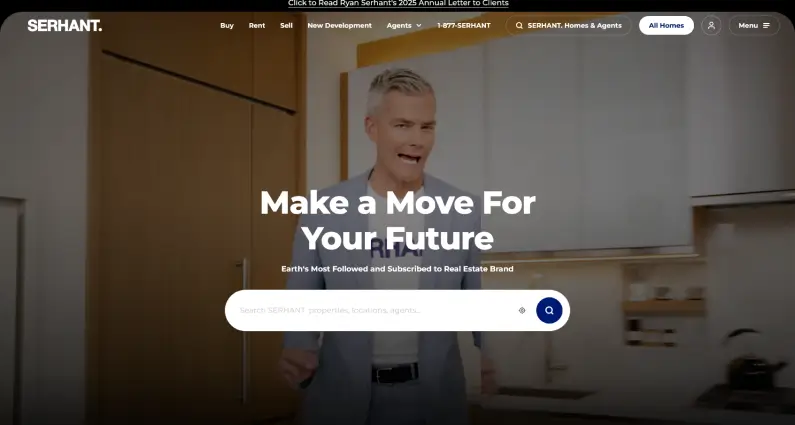
Homepage: Head to serhant.com and you’ll see the omnibar right in the hero. Type a neighborhood, agent, or team and it returns all three from one field.
Agent grid: Each agent gets a personalized subdomain, a mini-brand page with bio, active listings, and contact form.
Search: Boundary-draw map search, consistent with OneKey MLS integration visible on SERHANT.’s property search result pages. Neighborhood guides at /neighborhoods/[area-slug].
Branding: Signature cobalt blue. Bold capital wordmark with a period. “Make a Move For Your Future.” Media-company identity, not brokerage.
Take this: One unified search beats six scattered “search” links.
Skip this: Searching properties, agents, and teams at once works for a 200-agent brokerage. For a solo agent it creates decision paralysis. Use a standard property search bar instead.
2. Carolwood Estates (Beverly Hills, boutique brokerage)
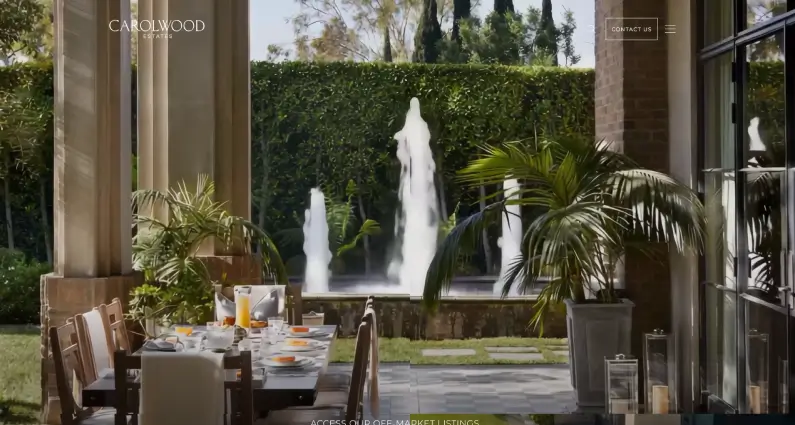
Homepage: Open carolwoodre.com and you’ll see no headline copy. The hero is a full-bleed property photo with three stat overlays: “$1.3B Off-market,” “$5B Sold in 2025,” “$2.2B On-Market.” Numbers replace copy.
Agent grid: Two-tier hierarchy. Associates at /associates, Leadership at /leadership.
Search: Full LP IDX with a Beverly Hills map boundary. Separate sections for Exclusive Listings, Solds, and Off Market (gated).
Branding: Cream, white, and charcoal. Carolwood is named after an actual Beverly Hills street; the local credibility is baked in. For high-net-worth buyers, that palette is worth stealing.
Take this: Use specific verifiable numbers as hero content. “$5B Sold” can’t be faked.
Skip this: The Off Market section works because Carolwood has billions in off-market deals. Without that substance, it reads as false scarcity the moment a buyer asks for inventory.
3. Jade Mills Estates (Beverly Hills, solo agent)
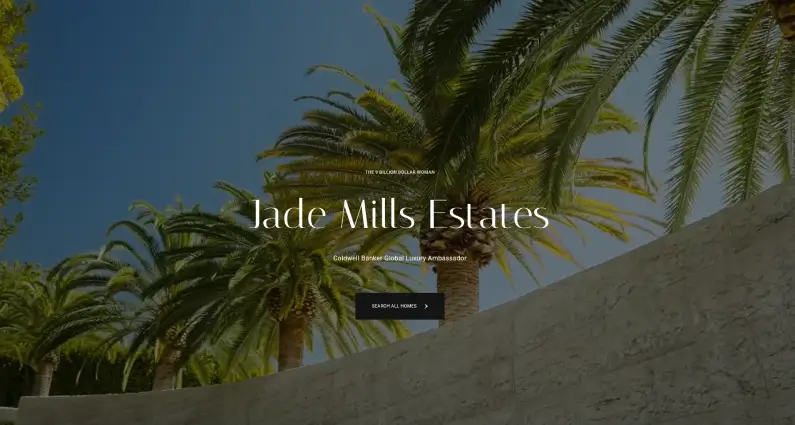
Homepage: Full-screen cinematic video hero, slow-pan and muted. Scroll past it and you’ll see a stat bar that beats a bio: “$9B+ career sales,” “#1 Coldwell Banker worldwide,” and the Inman Golden I Hall of Fame line.
Agent grid: Single “About Jade Mills” page. Photographer-grade headshots, no team roster.
Search: LP IDX at /home-search/listings. Neighborhood landing pages at /neighborhoods/beverly-hills. Recent sales at /properties/sale do the SEO lifting.
Branding: Gold and bronze, with a quiet serif. The site copy leans into the record book: “record-setting transactions exceeding $100 million.” For high-net-worth buyers, this is the color story to study.
Take this: Pick three or four ranked stats and arrange them as a credential bar below the hero fold.
Skip this: Autoplay video can be brutal on mobile without optimization. LP uses AVIF poster frames; on self-hosted or iframe video, mobile LCP suffers. Use a static hero with the video one scroll below.
4. Kumara Wilcoxon (Austin, TX, solo agent)
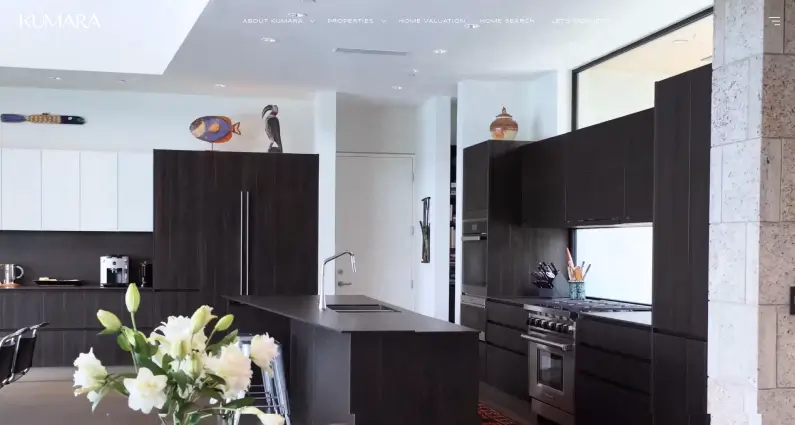
Homepage: Slow-pan video hero of Austin luxury properties, warm palette. You’d never know it’s a real estate site at first glance, and for a $1M+ market that’s intentional.
Agent grid: “About” expands to Meet Kumara, Meet the Support Staff, As Seen In, and Bespoke Marketing. The “Support Staff” page humanizes the team before a contact form ever loads.
Search: IDX pre-filtered for Austin at $1M+. Neighborhood dropdown: Downtown Austin, Lake Austin, Westlake, Tarrytown, Travis Heights, each linking to its own landing page.
Branding: Warm earth tones and a thin-weight serif. Press logos sit above the fold and do the credibility work before you say a word.
Take this: Pre-filter your IDX to your target price range. $200K listings on a $1M+ site dilute the brand instantly.
5. Ginger Martin + Co (Napa Valley, solo agent)
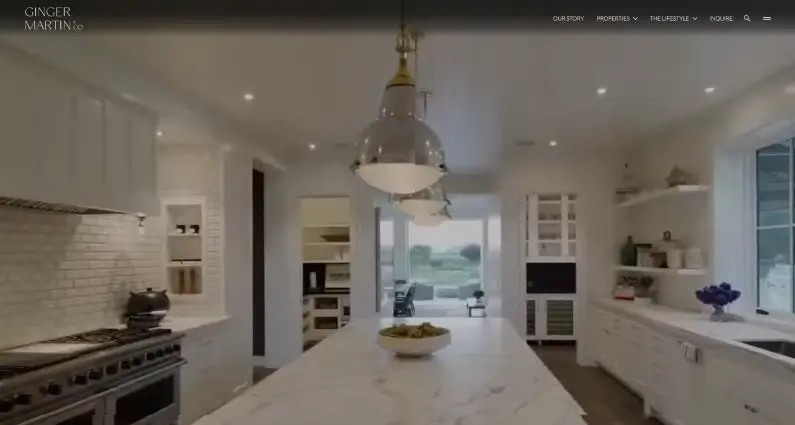
Homepage: Visit gingermartin.com and you’ll see a full-bleed still of Wine Country architecture. No video. A strong still image often outperforms autoplay video on mobile, where LCP is the bigger constraint. “$3B+ in all-time sales” sits prominently below.
Agent grid: Solo. “Who We Are” expands to Our Story and the bio page at /agents/ginger-martin.
Search: “Find a Home” expands to Exclusive Listings, Exclusive Leases, View All Listings, with a Napa vs. Sonoma drill-down. “Sell Your Home” opens onto Property Valuation and Notable Sales.
Branding: “The Lifestyle” nav leads to Blog and Communities, positioning Ginger as a Wine Country authority.
Take this: Add a “Lifestyle” section to your nav. A blog plus a local community guide pulls organic traffic IDX rarely ranks for.
6. Robin Kencel Team (Greenwich, CT, solo/small team)
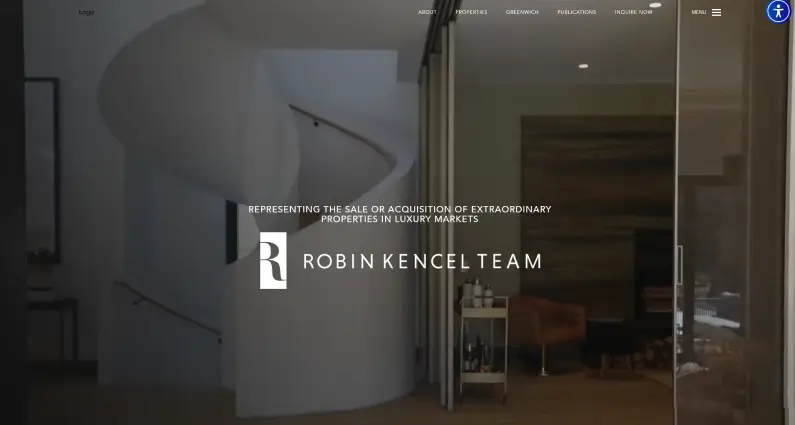
Homepage: Opens dark, near-black, with white serif type. Before you read anything, you know this isn’t a discount brokerage. The “Greenwich” mega-menu has seven sub-items: About Greenwich, Neighborhoods, Schools, Town Hall, Signature Events, Resources, Essential Resources.
Agent grid: “Meet the Team” at /team. A “Philosophy” page at /philosophy lets prospects self-select on values alignment.
Search: Exclusive Listings and Sold Listings only. No public MLS-wide search, a deliberate luxury positioning choice.
Branding: “The Source” newsletter, “In the Press” page, and blog target C-suite clientele who do due diligence first.
Take this: Build your nav around your market, not just your listings. A community mega-menu earns more trust than another “Search Homes” link.
7. Carlin Wright (New York City, solo agent)

Homepage: Head to carlinwright.com and you’ll see most agents bury their market reports in a blog. Carlin puts the data front and center. A “market intelligence” content block surfaces her expertise before a visitor decides whether to scroll.
Agent grid: Solo: the agent grid collapses to one “About” page. Editorial portrait, credentials list ($250M+ closed sales), and a market-insights block.
Search: LP IDX focused on the NYC market. Neighborhood pages for NYC submarkets.
Branding: Black, white, charcoal. No color at all. In Manhattan, that restraint signals “serious money” faster than a tagline.
Take this: Put one live market stat on your homepage: median list price, days on market, or last month’s sales.
8. Village Properties (Santa Barbara, large brokerage)
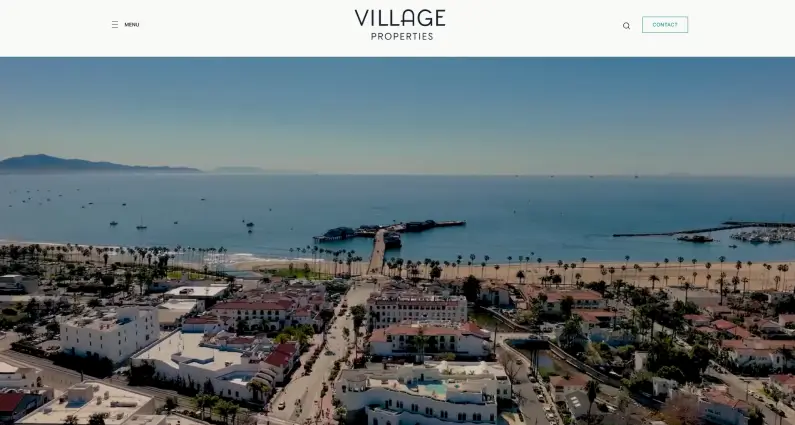
Homepage: Open villagesite.com and you’ll see no agent face in the hero. That’s intentional. The brand is the brokerage; a full-bleed Santa Barbara coastline anchors the “26+ years in Santa Barbara County” framing.
Agent grid: “Meet Our Agents” at /agents shows the full roster. Click into any agent pages entry and you get a full bio, active listings, and a contact form, not a placeholder card.
Search: Full LP IDX with a pre-encoded map boundary for Santa Barbara County. A separate Village Exclusives page.
Branding: Specialty pages in nav (Trusts, Estates, and Probates; Ranches, Equestrian, Vineyards, and Wineries) name niche expertise. Serve a specific buyer persona? Give them their own page.
Take this: Add specialty pages that name the buyer personas you serve.
9. Indigo Road Realty (Atlanta, GA, multi-agent team)
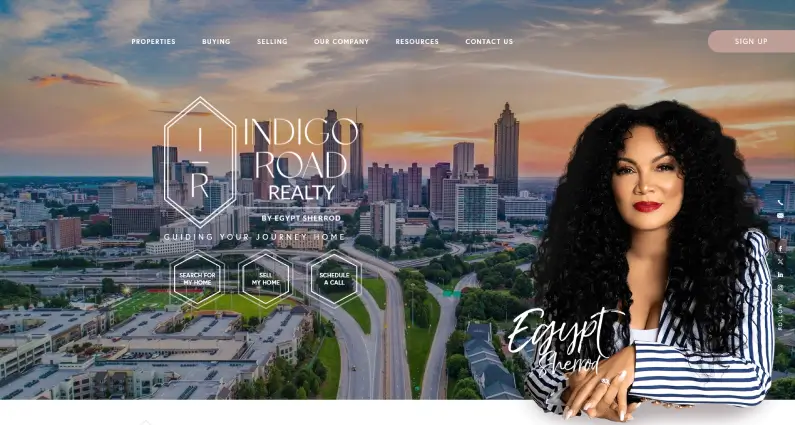
Homepage: Egypt Sherrod’s HGTV credibility (Married to Real Estate) is front-loaded. The hero is Egypt, not a property. When your personal brand earns trust before the listing does, lead with it.
Agent grid: “Our Agents” at /our-agents/. Egypt has her own page at /egypt-sherrod/. “Join Our Team” signals active growth.
Search: kvCORE IDX with map search and featured communities. The kvCORE search opens to a clean property page with photos, map, details, and a contact form. “Turnkey Program” is a named renovation service.
Branding: Indigo blue and warm neutral. The @EgyptSaidSo handle in site meta links personal brand to the brokerage.
Take this: Give your top service a branded name. “Turnkey Program,” “Strategic Guides,” “Bespoke Marketing” all signal methodology.
10. Living Telluride / Raible Team (Telluride, CO, two-person team)
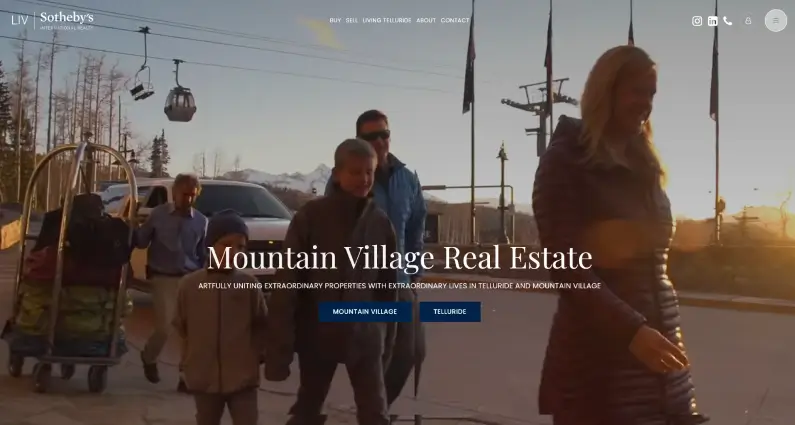
Homepage: Dark theme, dramatic mountain landscape hero. “Explore Telluride” sits as a CTA alongside “Buy” and “Sell.” The site doubles as a destination guide.
Agent grid: Husband-wife team. “Over 50 Years of Telluride Real Estate Experience” anchors the team page.
Search: Area guides at /our-areas/san-miguel-county/[slug]. AgentFire IDX. Social fully integrated (@livingtelluride).
Branding: Snow, gondolas, and ski lodge warmth in every shot. Every image sells Telluride, not just the listings.
Take this: Dark theme is underused in real estate. In resort markets, it tends to communicate premium without a word of copy.
11. Oasis Realty Group (Sarasota, FL, multi-agent team)
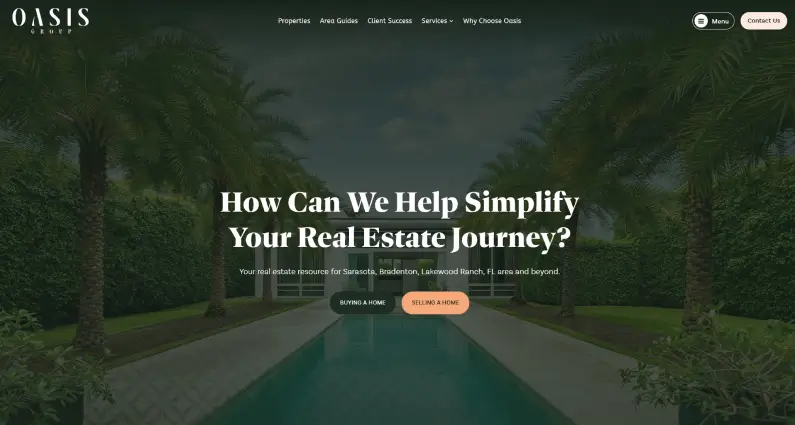
Homepage: Dark theme. Hero CTA: “How can we help simplify your real estate journey?” with two buttons routing buyers and sellers into separate flows. Above the fold: a “Zillow Top 1% in Customer Service & Satisfaction” badge.
Agent grid: Team photo with multiple agents, affiliated with LPT Realty. Competitive edge framed as client service, not transaction volume.
Search: Area guides at /area-guides/[area-slug] for Lakewood Ranch, Downtown Sarasota, and Bradenton, each with embedded property search. ClickMaps for geo navigation. RSS-to-MailChimp for new-listing emails.
Branding: Dark and modern, with vibrant Gulf Coast photography (pool, sunset, tropical). Voice: “We’re here every step of the way.” Friendly, not formal.
Take this: Replace “Browse Listings” with “How can we help?” A reframe from agent-centric to buyer-centric.
12. Path & Post Real Estate (North Atlanta, GA, boutique brokerage)
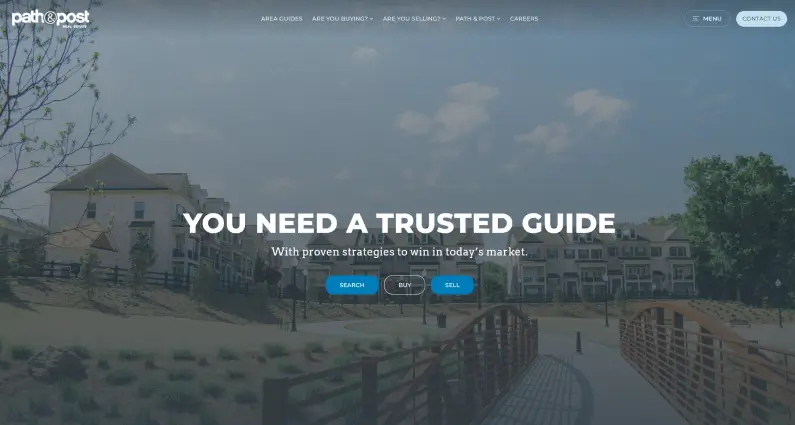
Homepage: Dark theme. Three CTAs (Search, Buy, Sell) and a “Zillow Top 1%” badge. Schema confirms 5.0 from 1,557 reviews. Not confidence, proof.
Agent grid: A multi-agent grid on AgentFire’s Team Link addon. The brokerage positions itself as a “local boutique.”
Search: ClickMaps addon powers an interactive map of North Atlanta submarkets (Woodstock, Canton, Roswell, Marietta, Alpharetta, Southern Highlands). The Neighborhood Quiz addon helps prospects self-select before contacting an agent.
Branding: The name Path & Post suggests direction and arrival. Olive and forest green primary palette.
Take this: Add a Neighborhood Quiz. It delivers leads who already know what they want.
Patterns worth copying across all 12 sites
- Cinematic hero, video or single still. SERHANT., Jade Mills, and Kumara use slow-pan video; Ginger Martin and Village Properties use one great still photo. Carousels underperform: Nielsen Norman Group research shows drop-offs past slide one and they hurt LCP. None of these 12 uses one.
- Dark-mode luxury. Living Telluride, Oasis, and Path & Post run dark themes on AgentFire. Dark signals premium: restraint, scarcity, editorial seriousness, the same reason luxury fashion tends dark.
- Numbers as hero content. Carolwood ($5B), Jade Mills ($9B), Ginger Martin ($3B). Stats replace taglines, when real.
- Neighborhood pages as infrastructure. Every LP site uses /neighborhoods/[slug]; every AgentFire site uses /area-guides/[slug].
- Named programs. “Turnkey Program,” “Strategic Guides,” “Bespoke Marketing.” A named program signals methodology.
How to get one:
Want a site like these? Here’s where to start.
- Pick two or three patterns that match your market.
- Check whether your current site supports IDX, neighborhood pages, and a valuation lead magnet.
- Choose a platform built for real estate from the ground up.
On WordPress, our pick is WPResidence (disclosure: it publishes this article). $49 a year, with IDX-ready templates, an agent grid, and neighborhood pages, everything you need to match the examples above without a custom-build invoice. See why a purpose-built wordpress theme for real estate agencies beats a generic page builder.
You might also want to check out:
- The Best Realtor Website Templates for Solo Agents
- Real Estate Website Templates: A Buyer’s Guide
- The Cheapest Real Estate Websites for Solo Agents
Key Takeaways
- Most 2024 buyers begin online, and most still buy through an agent (NAR 2024). Your site is the audition.
- All 12 sites here use neighborhood pages as their primary SEO and lead-generation asset.
- Autoplay video hurts mobile LCP; a static AVIF or WebP hero is usually safer unless your platform optimizes video delivery.
Frequently Asked Questions
How do solo agent sites differ from brokerage sites in UX?
Solo agent sites lead with one face and one set of credentials; the agent grid collapses to a single About page. Brokerage sites need a full roster with individual profiles, plus search UX that helps buyers find the right agent before the right home. Compare Carlin Wright (entry #7) with Village Properties (entry #8).
I’m a new agent without big sales numbers. What should I put in the hero?
Lead with what you have. Total transactions this year, neighborhood specialization, or your Google or Zillow reviews count. Path & Post (entry #12) leads with a Zillow Top 1% badge and 5.0 schema reviews from 1,557 ratings. Make it real; buyers can tell when numbers are inflated.
Which platform builds the best real estate agent websites?
Luxury Presence dominates the luxury segment (8 of 12 sites here). AgentFire is the strongest pick for neighborhood-focused sites and suburban teams. On WordPress and want to skip the Luxury Presence monthly fee? WPResidence is a purpose-built real estate theme with IDX-ready templates, agent-grid layouts, and neighborhood-page templates, starting at $49 a year. Any of these examples can brief your designer.