What Is a Real Estate Website Template?
Last updated: May 25, 2026
A real estate website template is a pre-built site designed for real estate professionals, with structures for property listings, search filters, agent profiles, and lead capture forms. They come as WordPress themes, website builder layouts (Wix, Squarespace, Webflow), or static design files, and most are customizable without code. If you’ve been Googling “real estate template” and “real estate theme” and aren’t sure if they’re the same thing, they mostly are; the words get used interchangeably.
The pattern we see over and over: an agent picks a clean-looking generic business template, gets the site live, then six months later discovers there’s no way to display 120 properties with filterable search. A real estate website template is a different category entirely. Most of this guide assumes the US or Canadian market, where MLS-driven IDX integration is the dominant pattern; readers elsewhere should still find the checklist useful but will need to swap MLS for the local equivalent (Rightmove, Zoopla, ImmoScout24, Idealista, and so on).
What a Real Estate Website Template Actually Is
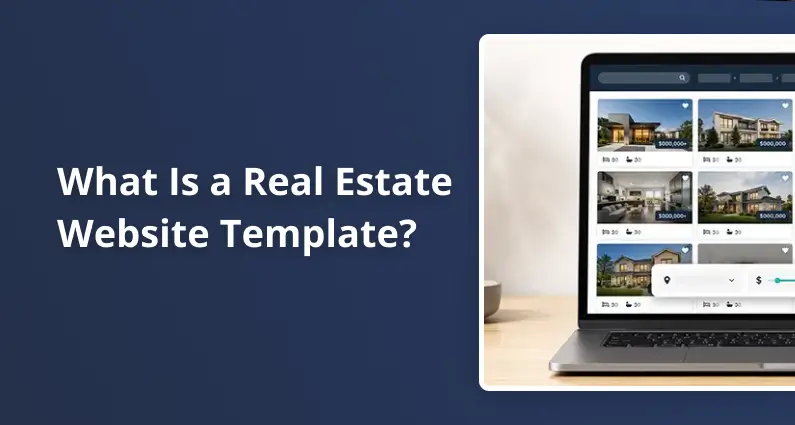
A generic business template gives you a homepage, an about page, and a contact form. A real estate template gives you all of that plus the specialized machinery a real estate business needs: structured property listing pages, filterable search, a map view, agent profile pages, and lead capture forms tied to individual listings.
The other distinguishing factor is whether the template runs on a content management system (a CMS: the database-driven admin panel you log into to add new listings) or whether it’s a bundle of design files a developer has to wire up. Real estate sites need the CMS-driven kind. Listing inventory changes every week, sometimes every day. You need a live admin panel where you can post a new property in two minutes, not a developer ticket every time a listing comes off the market.
The pattern we see: an agent picks a beautiful generic template, gets the site online, then six months later realizes there’s no way to display 120 properties with filterable search. They end up rebuilding on a real estate theme anyway.
“Theme” vs. “Template”: What Each Word Actually Means
This trips up a lot of people, including people who’ve been building sites for years. The two words are used interchangeably in marketing copy, but they are not the same thing. Here’s the four-way vocabulary map in plain English.
WordPress theme. A design-and-functionality package you install on a WordPress site. It controls how the whole site looks and what it can do.
Page template. A specific layout (like a single property page) that lives inside a theme. Not the same as buying a template.
HTML template. A static bundle of HTML, CSS, and JavaScript files. No database, no admin login. A developer’s starting point.
Website builder template. A starting design that lives inside a hosted platform (Wix, Squarespace, Webflow, Framer, Canva). You never download or own the files.
When most people Google “real estate website template,” they’re looking for either a WordPress theme or a website builder template. Same idea, different technical implementation. As our own article on WPResidence.net notes, Wix and Framer both rank for “real estate html template” even though neither sells a downloadable HTML file. The search results muddy the vocabulary because that’s where the traffic is.
Why Real Estate Sites Need a Specialized Template
Beyond a homepage and a contact form, a real estate site needs structured property listings, filterable search, an interactive map view, IDX/MLS integration, and lead capture tied to specific listings. A generic template offers none of those out of the box. Your site is your storefront. If buyers can’t quickly see photos, filter by neighborhood, and ask about a listing, they’ll search somewhere else.
Most real estate templates sold today are real estate WordPress themes: a package you install on a self-hosted WordPress site that handles all of the above out of the box. WordPress dominates the real estate niche because its plugin ecosystem (Showcase IDX, iHomefinder, IDX Broker, MLSImport, and others) runs deeper than any competitor.
An example: a solo agent sets up a listing page with photos and a price filter but skips the map view. A buyer searching near a specific school district gets a text list and cross-references each address in Google Maps. On the third property, they navigate to Zillow. Skipping the map view cost the lead.
The Four Flavors of Real Estate Templates
WordPress Themes
You install the theme on a self-hosted WordPress site and own the files, database, and content. WordPress powers over 40% of all websites, per WordPress.com’s reporting of W3Techs tracking. Top real estate themes sell for around $79 one-time on ThemeForest. Trade-off: you manage hosting, backups, and updates, but modern themes include one-click demo importers to get live quickly.
HTML/CSS Templates
Static file bundles with no PHP, no database, and no admin login. Best for developers building a fixed-content site (a single luxury listing page, a short campaign site). Real estate HTML templates run $17 to $60 one-time per our WPResidence.net comparison. No native IDX support.
Website Builder Templates (Wix, Squarespace, Webflow, Framer)
Drag-and-drop hosted platforms. Wix and Squarespace are the most beginner-friendly; Webflow and Framer skew designer-oriented. The real estate catch: native MLS support is limited or nonexistent on Wix and Squarespace. Webflow integrates with IDX providers via embeds, but the setup is more involved. You also don’t own your files, so migrating off the platform later is painful.
The scenario we see: a new agent builds a clean Wix site and manually lists her eight properties without issue. Eighteen months later she joins a team, needs to show 300+ MLS listings, and discovers Wix’s IDX options are too limited. She rebuilds on WordPress.
Hosted SaaS Real Estate Platforms
Purpose-built platforms like Placester sell a turnkey package: hosting, design, IDX, and CRM in one subscription. Placester pricing (as of 2026) runs $59 to $129 per month plus $25 per month per MLS connection, making the true entry cost with one MLS roughly $84 per month. IDX works out of the box. Trade-off: higher ongoing cost, no file ownership, less customization.
What to Look For in a Real Estate Website Template
- Property listing pages with photos, filters, and map view
- IDX/MLS integration or documented plugin compatibility
- Lead capture forms tied to individual listings
- Mobile-responsive design and fast load times
- Active developer support and recent updates
- Transparent pricing with no surprise add-on costs
- Clear documentation and setup guides for beginners
- Agent and agency profile management
Property Listing Essentials
Every property page needs a high-resolution photo gallery, structured fields for beds, baths, square footage, and price, a floor plan upload, and a mortgage calculator. Search needs to filter by price range, bedrooms, property type, and location.
Map view is not optional. Per the NAR 2025 Profile of Home Buyers and Sellers report, photos, detailed property information, and floor plans are the most valuable content for buyers (41%, 39%, and 31%). Agents whose sites lack an interactive map lose buyers who search by neighborhood. Inline inquiry forms belong on individual listing pages, not a sitewide contact page, so each lead routes to the right agent.
IDX and MLS Integration
This is the single most important feature for US-based agents. From Luxury Presence’s IDX vs. MLS explainer: MLS (Multiple Listing Service) is the cooperative database where agents share property data; IDX (Internet Data Exchange) is the technology that displays those listings on your website. The MLS is the database; IDX is the pipe. Standalone plugins typically cost $50 to $100+ per month, and MLS dues run $200 to $800 per year. The key question to ask of any theme: does it work with standard IDX plugins (MLSImport, Showcase IDX, iHomefinder, IDX Broker), or does it require a proprietary add-on? As the MLSImport beginner guide explains (in-house disclosure: MLSImport is built by our team), miss any layer of the IDX stack and the chain breaks.
Design, Responsiveness, and Mobile Performance
Mobile-first is non-negotiable. Property pages load lots of high-resolution photos, and a theme with unoptimized images can hit a 5+ second load time on mobile. The real test is loading the demo on your phone before you buy. Google measures performance through three Core Web Vitals. Per Google’s Search Central documentation, the current thresholds are:
- LCP (Largest Contentful Paint): how long the main content takes to appear. Aim for under 2.5 seconds.
- INP (Interaction to Next Paint): how quickly the page responds when a visitor taps or clicks. Aim for under 200 milliseconds.
- CLS (Cumulative Layout Shift): how much content jumps around as the page loads. Aim for less than 0.1.
INP replaced the older FID metric in March 2024. Any theme checklist still citing FID is outdated. Run the theme’s live demo through Google PageSpeed Insights before buying.
Support, Updates, and Total Cost
The theme you buy today must work with future WordPress and PHP releases. Check the public changelog: no update in 90 days is worth investigating, and 18+ months means likely abandoned. Step-by-step documentation matters for beginners: it is the difference between launching in a week and being stuck for months. The theme price is not the full cost: add hosting ($10 to $30 per month) and an IDX plugin ($50 to $100+ per month if you need MLS data). Most ThemeForest licenses cover a single site with six months of author support.
Red Flags to Watch For When Choosing a Template
Flag 1: Nulled or cracked themes. “Free downloads” of premium themes from forums or sketchy sites are pirated copies. Sucuri’s 2023 report documents that nulled themes carry hidden backdoors used for stealing data, injecting SEO spam, and creating rogue admin accounts. A legitimate license costs far less than a hacked-site cleanup.
Flag 2: Abandoned themes. Real estate themes need maintenance: WordPress core updates twice a year, PHP version changes, security patches. If the changelog shows no update in 18+ months, look elsewhere. ThemeForest shows the “last updated” date on every listing.
Flag 3: IDX gated behind a proprietary add-on. If a theme’s “IDX support” is a separate paid plugin you can only buy from that same developer, that’s vendor lock-in. Better: themes that document compatibility with standard IDX plugins so you can pick your provider and swap without rebuilding.
Flag 4: Demos with poor Core Web Vitals. Run the demo through Google PageSpeed Insights before buying. If mobile LCP exceeds 4 seconds or INP is over 400 milliseconds, the live site with your real content will likely score worse.
Where to Find Real Estate Templates
ThemeForest (themeforest.net) is the largest marketplace for premium real estate WordPress themes, with around 2,500+ real estate template results (live count, late May 2026). Top WordPress themes (Houzez, WPResidence, RealHomes, Real Estate 7) are listed here with sales totals, ratings, last-updated dates, and preview demos.
WordPress.org’s free theme repository and developer storefronts. The official WordPress.org repository hosts audited, free real estate themes; fewer features than premium options, but legitimate and safe. Some theme developers also sell directly from their own sites, occasionally with bundled extras.
Site builder galleries. Wix, Squarespace, Webflow, Framer, and Canva each have their own real estate template galleries inside their platforms.
A quick note: WPResidence is our own theme, so take this as a starting point for your shortlist, not an unbiased verdict. It covers the checklist above: property listings, IDX compatibility (including MLSImport, which our team also builds), advanced search, agent profiles, and lead capture. Per the ThemeForest listing’s structured data, as of May 2026 it carries a 4.85 out of 5 rating based on 1,644 reviews, with updates on a near-monthly cadence.
Key Takeaways
- A real estate website template is a pre-built layout with purpose-built features (property listings, IDX, map search, lead capture) that a generic business template cannot provide.
- On WordPress these are called “themes”; on Wix, Squarespace, or Webflow, they’re called “templates”; same idea, different platform.
- IDX integration is the single most important feature for US real estate agents, and standalone plugins typically cost $50 to $100+ per month per Luxury Presence’s IDX FAQ.
- Google’s current Core Web Vitals thresholds are LCP under 2.5 seconds, INP under 200 milliseconds, and CLS under 0.1; INP replaced FID in March 2024.
- Before buying any real estate theme, check the public changelog: no update in 18+ months is a red flag, and nulled themes carry documented security backdoors.
Frequently Asked Questions
Do I need my own real estate website if I already have a Zillow profile or a brokerage site?
Yes for most agents. Brokerage and portal pages route leads through the platform, which may share them with competing agents or bury your contact info. Your own site captures inbound traffic under your URL and stays with you when you change brokerages. A WordPress real estate theme like WPResidence is the standard setup. If you work purely from brokerage referrals you may not need one yet, but most agents do.
Does this guide apply outside the US and Canada?
Partly. The “what to look for” checklist (search filters, mobile speed, lead capture, agent profiles) applies anywhere, and most WordPress themes including WPResidence are sold globally. The IDX/MLS section is North American: outside the US and Canada, listing data comes from portals like Rightmove and Zoopla (UK), ImmoScout24 (Germany), or Idealista (Spain). Confirm your theme supports the data source your local market uses before buying.
Can I build a real estate website without coding?
Yes. WordPress real estate themes like WPResidence install through the WordPress admin dashboard with no code required, and most include one-click demo importers. Site builders like Wix, Squarespace, and Webflow offer drag-and-drop editing with no code at all. The trade-off: no-code builders have limited IDX support, while WordPress themes give you full site ownership and the deepest IDX ecosystem.
How much does a real estate website template cost?
A premium WordPress real estate theme typically costs around $79 one-time on ThemeForest. HTML templates run $17 to $60 one-time per WPResidence.net. Site builder templates are free with a platform subscription ($16 to $49 per month for Wix or Squarespace). Hosted real estate platforms like Placester start at $59 to $129 per month plus $25 per month per MLS. The template itself is rarely the biggest ongoing cost: IDX, hosting, and premium plugins add up separately.
If you’re comparing real estate website templates, the best real estate WordPress theme roundup covers the top options side by side. If you’re ready to start, how to build a real estate website walks through the full setup.