
WPResidence handles agent profiles, listing management, lead routing, and role controls on WordPress.
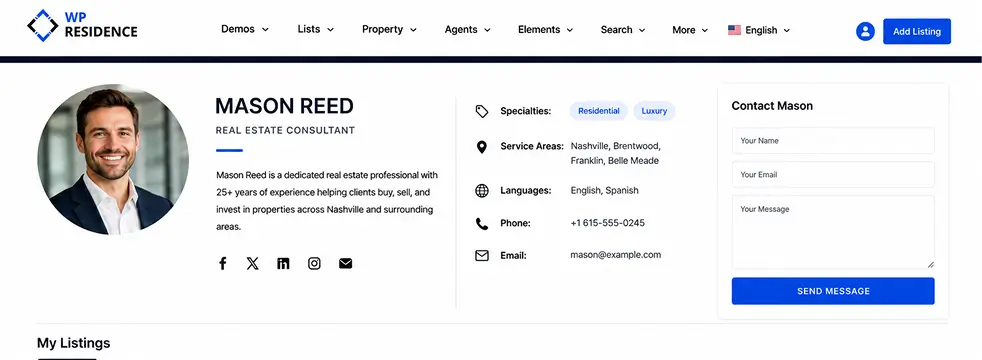

Every Agent, Agency, or Developer account in WPResidence automatically generates a public profile page that lists that user's active and sold properties. Registering as an agent spins up a profile and links every property assigned to them.
Each profile stores a photo, bio, specialties and service areas, languages spoken, phone, email, social links, and a built-in contact form. The agent's listings render in a grid below the bio, so a single page works as both a "hire me" pitch and a live inventory feed.
Styling stays consistent across the team: profile pages are built with WPResidence Studio templates or Elementor, so the global header, footer, and typography hold the brand together while each agent differs by photo, bio, and specialties. Shortcodes and widgets render team grids, agent or agency directories, and blocks like "Listings by John Smith." You can preview the options across the 50 one-click demo sites of this real estate WordPress theme first.
The Agents List page offers 5 agent card styles, and profile pages come in 2 layouts. For a custom design, build a Single Agent, Single Agency or Single Developer template in WPResidence Studio and apply it to all profiles or only to one agency category, city or area. The template's widgets cover the name, photo, contact form, call, WhatsApp and email buttons, listings, reviews, specialties and custom fields.
When an agent leaves and you reassign their listings, the property URLs and content stay exactly the same, so links and rankings stay with the site.
There are five account types in total: three professional roles (Agent, Agency, and Developer), plus a Regular User role and the WordPress Admin. The Developer role is built for builders showing projects and units.
Agency is its own account type. It gets its own profile page showing the company logo, a description, office contact details, a team roster, and the combined inventory of every linked agent. A form on the agency page routes leads to the agency email and the linked agents, and one agency can run 5 or 50 agents under one umbrella, each keeping their own profile.
Agents, agencies and developers each have their own categories, cities, areas and states, so visitors can filter the directory by what and where each one sells.
The same property can be assigned to more than one agent and shows correctly on each agent's profile, which matters for co-listed deals. On multilingual sites, each property's language versions are linked, so a price update syncs to all languages.

Agents and owners log into the front end of the site and manage their entire workflow (listings, profile, messages, invoices) from a dashboard built out of ordinary WordPress pages. Each tab is an optional template page and appears once its page exists.
The core tabs are My Profile, My Properties, Add or Submit Property, Favorites, Saved Searches, Messages, Invoices, and CRM, laid out as either a top bar or a side menu (agencies tend to favor the side menu, solo agents the top bar).
Agency and developer accounts also get Add Agent and Agents List tabs, so the agency creates its agents' accounts and edits their profiles from the front end. An Analytics tab shows views and inquiries per listing.
The Submit Property form carries most of the daily work. Admins control which fields show, whether each is required, and their order.
A drag-and-drop uploader handles photos, PDFs, floor plans, virtual tour links, and video URLs, and agents reorder the gallery and set the featured image from the form. The form uses a tabbed layout (Details, Media, Location, Price) and saves drafts. The image limit is an admin setting, commonly 20 to 30 and configurable up to 40, with uploads restricted to JPG, PNG, and PDF.
The My Properties tab is the management table: agents edit, duplicate, or delete listings and flip a status to Sold, Featured, Expired, or Active in one click, with per-listing analytics showing views and inquiries. Guest submission is supported too, but a visitor must register right before saving, and the listing stays Pending until an admin approves it.
The Custom Fields Builder lets you add unlimited custom fields (text, number, date, dropdown) through a visual builder, and they flow into the submit form, the single-property template, the property cards, and advanced search at once.
You can even build different submission forms per property type, so a rental asks for deposit and minimum stay while a sale asks for year built and HOA fee. Compared with Houzez and RealHomes, WPResidence gives you more control over submission logic: Houzez ties field behavior to its CRM, and RealHomes uses a fixed tabbed wizard. Our WPResidence vs Houzez and WPResidence vs RealHomes comparisons cover the differences.
You can test it before buying. WPResidence's demos include agent logins, so you can publish a sample listing yourself and time it. The dashboard keeps "Add Property" and the edit controls a click or two from the front page.
A realistic submission runs in a predictable order: title and price, then location, then features, then media. Location follows a strict State, then City, then Area hierarchy, with address auto-complete through Google Places or OpenStreetMap. Listings sort into seven default taxonomies: Category, Type, City, Area, State, Status, and Features, so buyers can filter precisely.
Brokerages that add listings centrally can disable front-end submission by unpublishing the Submit Property page and turning off open registration. The result is a read-only catalog that office staff fill from wp-admin, while every other dashboard function (profile, messages, CRM) stays available for the agents who still need it.

The user separation toggle is the central permission control. With it on, each agent can see and edit only their own listings; with it off, the broker owns all listings and agents edit only what they're assigned.
WPResidence has five account types: Agent, Agency, Developer, Regular User and Admin.
Agents see and edit only their own listings. Agency accounts see and edit their whole team's inventory. Full admins can edit anything from wp-admin.
Approval runs by risk level. New Agent, Agency, and Developer accounts land as Pending until an admin publishes them, while Regular Users can be set to auto-approve. Admins can lock specific fields, such as the property slug or certain taxonomies, and theme options let you tick which dashboard menu items appear for each role.
For a Property Manager role that edits all properties while theme options and payment gateways stay with the admin, clone the Agent capabilities with a standard WordPress role-editor plugin. The built-in labels (Agent, Agency, Developer) are fixed, though you can rename them in signup text and translation strings; genuinely new roles call for a role plugin.
WPResidence keeps roles simple by design. RealHomes and Houzez expose finer-grained capability checkboxes and permission matrices, so if you need surgical control over dozens of individual capabilities out of the box, those themes give you more switches. WPResidence covers the common brokerage cases with sensible defaults and leans on a role plugin for the edge cases.

Every listing inquiry in WPResidence routes to the email of the agent assigned to that listing; if no agent is set, a site-wide fallback admin email fires instead.
Built-in inquiry forms sit on every listing page, every agent profile, and every agency page, plus a Schedule-a-Tour form. The theme auto-injects the property title and link into each message, so the agent always knows which property the lead is about. The routing path runs like this:
Agency-page forms route to the agency address and notify both the agency and its linked agents, and developer forms route to the developer. For listings imported through MLSImport, office-code mapping sends each one to the correct branch or agent. For rotation across a team, use HubSpot's assignment rules.
Schedule-a-Tour adds a date and time picker; the request is stored and emailed with the chosen slot and the listing ID. For a calendar with availability and booking limits, embed a tool like Calendly, Amelia or Bookly.
Forms drop into the sidebar, below the listing details, or inside the gallery lightbox without code, and WhatsApp and click-to-call buttons can sit beside them. Email templates are editable per role and per event (new lead, new listing, approved listing, expired membership), and subject-line tokens like city, type, and property ID let you build mail-filter rules.
The built-in WPEstate CRM stores every form submission as a lead, capturing name, email, phone, property context, and moves through editable stages from New Lead to Closed Won. Each agent sees only their own leads; the admin sees all and can export them. Because leads live in the database, they survive a bounced notification email. Agents work the leads from 8 front-end CRM pages: Contacts, Leads, Enquiries, Deals, Tasks, Activity, Automations and Stats. 27 ready-made automation rules handle assignment and follow-up reminders, deals move across a board view, and SMS goes out through Twilio.
Native HubSpot integration pushes form data through an API key, with a separate key per agent, and other CRMs (Salesforce, Zoho, Pipedrive, Google Sheets) connect through Contact Form 7, Gravity Forms, or WPForms plus Zapier. Our Elementor lead form sends to Zapier or Make through webhook URLs.

WPResidence supports recurring membership packages, pay-per-listing, or a mix of both, plus one-time fees. Each plan specifies a price, how many listings it allows, how many days they stay active, and how many featured slots the account receives. When an account hits its cap, new published listings are blocked until it upgrades.
Payments work out of the box with built-in PayPal and Stripe, and bank or wire transfer is supported offline. WooCommerce is optional: you only need it for extra gateways, complex tax, or a different checkout.
The My Invoices front-end page lists every purchase (memberships, paid listings, featured boosts) with IDs, amounts, and dates, and WooCommerce orders surface there too. You can also tie auto-publishing to packages: hold all new listings as Pending globally, then let paid tiers publish instantly.

A single WPResidence install can run as a solo-agent brochure site today and grow into a multi-agency portal later, by toggling roles, dashboards, and payments in theme settings rather than migrating to a different theme. You start with only the Agent role, registration hidden, and payments off, then flip on the Agency and Developer roles, the front-end dashboards, memberships, and payment gateways as the business grows. Enabling a role auto-adds its menus; disabling it cleans them up.
For thousands of listings, plan for a VPS or managed WordPress host with page caching. WPResidence needs WordPress 6.7 or higher, PHP 8.0 or higher and MySQL 5.6 or higher; our server requirements article lists the recommended PHP limits.
For social proof, WPResidence's ThemeForest listing reports 32,000+ buyers and 1,600+ reviews averaging 4.85/5.

WPResidence is built around native WordPress listings but integrates with MLS and IDX feeds, and MLSImport is the default path (an in-house product, and this article is published on wpresidence.net). It uses the RESO Web API to pull MLS listings into WordPress as native property posts, each with its own indexable URL and the same templates and search as your manual listings. Imported listings behave like any other property, gaining reviews, favorites, and saved-search support, and office codes map them to the correct agent or agency.
WPResidence also coexists with hosted IDX plugins such as iHomefinder, dsIDXpress, and Realtyna for board search, while your native listings stay branded and indexable. Iframe-style IDX listings load from the provider's server, so they use the provider's templates and the SEO goes to the provider.
On data ownership, properties are a standard custom post type, while users and leads sit in normal WordPress tables, all exportable via CSV, XML, or REST. Switching hosts or themes keeps your content intact, and Elementor and Studio layouts are the one part you rebuild. A REST API at the path /wp-json/wpresidence/v1/properties, with matching endpoints for agents, agencies, and developers, supports full create, read, update, and delete operations for external CRM sync.