
Niche Websites

Niche Real Estate Websites: What Each Market Needs

What luxury, commercial, property management and brokerage websites need, and which parts WPResidence covers.
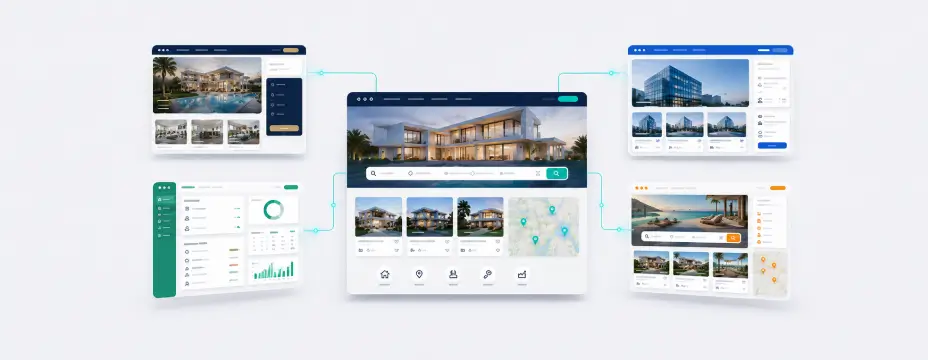
wpresidence.net
Niche real estate website on screen
4
niches in this guide: luxury, commercial, property management, brokerage
50
one-click demos, including luxury and commercial
800+
MLS feeds through MLSImport
96%
of home buyers start their search online (NAR 2025)

Last updated: September 28, 2026

A niche real estate website is built around one type of property business: its listing fields, search filters, media and the people it serves. A commercial site shows cap rate and net operating income, a luxury site leads with photos, video and 3D tours, and a property management site serves tenants, owners and managers.

The NAR 2025 Profile of Home Buyers and Sellers found that 96% of home buyers now start their search online, so the website is often the first contact a niche audience has with you. This guide covers four niches (luxury, commercial real estate, property management and brokerage), what each one needs, and which parts WPResidence covers.

On this page:

The Fundamentals

What Makes Niche Real Estate Websites Different?

5 dimensions define a niche

Two sites can run the same theme and look alike, while one sells $8 million estates and the other leases Class B office space. What makes each one a niche site is how it handles five things:

  1. Listing fields. Cap rate and NOI for commercial, rent and unit details for rentals, lifestyle amenities for luxury.
  2. Search filters. Visitors search by the fields that matter in that niche.
  3. Media. Luxury buyers expect large galleries, video and 3D tours; commercial buyers expect documents.
  4. Trust signals. Agent profiles and reviews, financial data or MLS compliance, depending on the niche.
  5. Workflows. Lead routing for brokerages, tenant and owner portals for property management, offering memorandums for commercial.

Strong real estate website design starts from these five points. In a real estate WordPress theme like WPResidence, the custom fields builder adds niche fields to listings and to the search form, and the property page can show video, virtual tours, floor plans, documents and multi-unit tables.

Luxury Vertical

Luxury Real Estate Websites

$338B US luxury market by 2030
Luxury real estate website mockup with full-bleed villa hero, cinematic gallery, and elegant enquiry panel
Luxury
20+ photos with full-screen lightbox
Matterport 3D and drone video
Quiet-luxury editorial copy and palette
Agent personal branding up front

The US luxury residential market is valued at roughly $289 billion today and projected to exceed $338 billion by 2030, per Mordor Intelligence data reported by HousingWire in November 2025.

A luxury real estate website needs four things. First, the visual production bar: at least 20 photos per listing with full-screen lightbox, Matterport 3D tours embedded on the page, and cinematic drone video in the hero.

Second, a quiet-luxury aesthetic: a restrained palette and editorial copy that tells a lifestyle story instead of reciting specs. DMR Media notes that gold, black, and white schemes read as elegance and exclusivity. Third, agent personal branding, where Christie's and Sotheby's present agents as cultural curators. Fourth, enough detail for cash buyers to decide before they call.

Realtor.com data reported by HousingWire shows roughly half of sales between $2 million and $5 million, and more than 65% between $5 million and $10 million, are all-cash. In practice, these buyers tend to vet extensively online before making contact, so the media and editorial layers carry real weight.

Christie's International Real Estate is the reference model for luxury real estate website design: curated inventory from its own agents, listings presented through lifestyle editorial copy, and agents positioned as art-world curators. Sotheby's International Realty runs a comparable setup. As Miami agent Ana Bozovic told HousingWire, "The higher up we go in price or price per square foot, the more all-cash our market is".

Large galleries and video need good hosting and a CDN. In WPResidence, each listing can show a full-screen gallery, YouTube, Vimeo or TikTok video and a virtual tour embed such as Matterport, and the luxury demos start from this layout. See how to build a luxury real estate website from the ground up, or explore the best luxury real estate websites for design and feature inspiration.

Commercial Vertical

Specialized Commercial Real Estate Websites

$815.6B active CRE listings (Crexi)
Commercial real estate website with office and retail listings, asset-type filters, and cap rate and square footage widgets
CRE
Cap rate, NOI, price PSF
Building class and lease type
Offering-memorandum document tooling
Financial data above the fold

CRE buyers are professional decision-makers who screen by financial metrics before they look at a photo. The listing page has to show the numbers.

A CRE site shows these fields: cap rate, net operating income, price per square foot, building class (A, B, or C), occupancy rate, and lease type (triple-net, double-net, gross, modified gross). Lease listings add tenant-improvement allowance and rent escalation schedules; industrial properties add clear height, loading docks, power in amps, and rail access.

Crexi reported $815.6 billion in active sales listings through November 2025, up 16.7% year over year, in its December 2, 2025 release.

As Michael DeGiorgio, Founder and CEO of Crexi, put it, "The pace of CRE deals today isn't just set by the market. It's also shaped by the tools people are using."

The other half is document production. Every CRE deal runs on an offering memorandum (OM). Sam Losek of CREBuilder, a CRE marketing-software firm, argues: "The broker who gets a polished OM in front of qualified buyers on day one of exclusivity wins more deals."

Offering memorandums are made in CRE software. In WPResidence, you add cap rate, NOI, building class or lease type as custom fields, show them on the listing and in search, and attach the OM as a PDF in the listing's documents section. The commercial and land demos start from this setup. Browse the best commercial real estate websites for platform comparisons and feature benchmarks.

Property Management

Property Management Websites

$119.1B 2024 US PM industry revenue
Property Management Websites
PM
Tenant portal with online payments
Owner real-time financial dashboard
Vacancy syndication to major portals
Tenant screening and work-order routing

A property management website is an operational portal as much as a listing site. The US property management industry generated an estimated $119.1 billion in 2024 revenue across 304,000 businesses, per iPropertyManagement.com, with 84.6% of that coming from residential management.

A PM website serves three audiences, each with its own portal:

  1. Tenants pay rent online and send maintenance requests.
  2. Owners see income, expenses and occupancy for their properties.
  3. Managers list vacancies, screen tenants and route work orders.

Two well-known platforms handle this. Buildium typically positions itself for small-to-midsize residential portfolios with a streamlined admin dashboard. AppFolio targets larger operations with AI-driven maintenance routing and role-based permissions. Both run alongside a marketing site.

The WordPress site handles marketing and vacancy listings, and the PM platform handles rent, maintenance and owner reporting. For the WordPress side, see the property management website template. In WPResidence, each vacancy is a property listing with its rent as the price and a label such as "per month" after it. Each listing also has a second price, so a property offered for sale and for rent shows the sale price first and the rent second. A building can list its apartments or units as subunits on its own page, and tenants request viewings through the schedule tour form. All 50 demos import in one click.

Brokerage Vertical

Real Estate Brokerage Websites

800+ MLS feeds through MLSImport
Real Estate Brokerage Websites
Brokerage
Multi-agent roster with IDX views
Native IDX across MLS boards
Round-robin and geographic lead routing
MLS compliance and logo display

A brokerage website needs four things:

  1. Agent roster. A profile page for every agent, with their own listings.
  2. IDX. MLS listings shown on the site, from every MLS board the brokerage works with.
  3. Lead routing. Each lead reaches the right agent.
  4. MLS compliance. Listing brokerage and MLS logo shown as the board requires.

Compass shows what real estate brokerage website IDX integration looks like at scale. Each agent gets a personal sub-site that inherits the Compass brand system, and Compass Luxury (luxuryatcompass.com) runs as a curated high-end sub-brand. Compass gives each agent its own CRM and marketing tools.

In WPResidence, each agent and office gets a profile page with its own listings, every contact form sends the lead to the listing's agent and saves it in the built-in CRM, and MLSImport imports MLS listings as properties on your own domain, where search engines index them. MLSImport can show each imported listing with its listing agent and office from the MLS feed, and HubSpot adds round-robin lead assignment. The brokerage demos start from this setup. Agents and teams starting from WordPress can explore the real estate broker WordPress theme built for multi-agent workflows.

At a glance

How the Four Verticals Compare at a Glance

Vertical Primary audience Must-have data fields Must-have site feature Key trust signal
Luxury High-net-worth buyers, investors Price, size, location, lifestyle amenities Full-bleed gallery (20+ photos), Matterport 3D, drone video Agent personal brand, editorial listing copy
Commercial (CRE) Investors, tenants, brokers Cap rate, NOI, lease type (NNN/Gross), price PSF, building class Financial data layer on listing page, document vault / OM access Financial data accuracy, broker credentials
Property Management Tenants, property owners, managers Vacancy details, rent, unit specs Tenant portal (payments, maintenance), owner financial dashboard Transparent reporting, responsive maintenance workflow
Brokerage Homebuyers, sellers, agent recruits Price, beds/baths, school district, agent specialization Multi-agent roster, lead routing, IDX listings on your own domain MLS compliance display, agent production data
Choosing a Platform

Choosing the Right Starting Point for Your Niche Site

4 niches on one theme

One WordPress theme can run the listing side of all four niches. WPResidence starts from 50 real estate website templates grouped by niche, including luxury, commercial and land, and brokerage. Custom fields add niche data, the search forms filter by it, and WPResidence Studio designs the property and agent pages. Each niche adds its own tools on top: CRE software for offering memorandums, a PM platform for tenant and owner portals, and MLSImport for MLS listings.

See how the property page layout adapts to each vertical, or browse the clients showcase for real-world examples of niche real estate websites built on this platform. The property card composer controls which fields appear on listing cards, so a commercial card can show cap rate and a rental card can show rent.

At a glance

Key Takeaways

The main points of this page.

What makes a site niche

A niche real estate website is defined by its listing fields, search filters, media and workflows; a commercial site shows cap rate and NOI on every listing.

Luxury

Luxury sites lead with large galleries, video, 3D tours and agent branding. The US luxury market is projected to pass $338 billion by 2030 (Mordor Intelligence via HousingWire).

Commercial

Commercial sites show financial data first: cap rate, NOI, price per square foot, building class and lease type, with the offering memorandum attached.

Property management

Property management sites serve tenants, owners and managers. The WordPress site handles marketing and vacancies, and a PM platform handles operations.

Brokerage

Brokerage sites need agent profiles, IDX listings on the site, lead routing to the right agent and MLS compliance.

WPResidence

WPResidence runs the listing side of all four with niche demos, custom fields, search filters and Studio templates; CRE software, PM platforms and MLSImport add the rest.

Frequently Asked Questions

What are niche real estate websites?

Niche real estate websites are platforms engineered for one vertical, such as luxury, commercial, property management, or brokerage, with vertical-specific data fields, search filters, and trust signals. A CRE site exposing cap rate and NOI is structurally different from a residential portal, even one with far more inventory. WPResidence covers the listing side of each niche with custom fields and niche demos.

What real estate niches make the most profitable websites?

Commercial real estate (high deal values, financial-data requirements), luxury residential (high commissions on low volume), and property management (recurring revenue) justify dedicated sites most clearly. Each audience looks for its own data: cap rate for investors, large media for luxury buyers, rent and availability for tenants. WPResidence can run the listing site for all three, with CRE or PM software added where needed.

How do I build a niche real estate website?

Start with a real estate WordPress theme that supports custom fields and niche search filters, then add the tools each niche needs: MLSImport or another IDX provider for brokerage or luxury, CRE marketing software for commercial, and dedicated PM software for property management.

What are examples of niche real estate websites?

Christie's International Real Estate represents luxury, with curated inventory and editorial copy. Crexi represents CRE, reporting $815.6 billion in active listings with cap-rate search. Buildium and AppFolio represent property management portal architecture.

Compass represents brokerage, with per-agent sub-sites inside one brand system. WPResidence can run the listing side of each through custom fields, niche demos and Studio templates.