
Every feature a real estate website needs: property search, IDX, CRM, agent profiles, and which to skip. Based on NAR 2024 data.
Last updated: June 3, 2026
Most agents scoping a build cannot tell which real estate website features they truly need, so split them into two: a universal core at launch, and a conditional layer tied to your business model. The core is property listings on a structured property page, advanced filtered search, an interactive map, lead capture forms, agent profiles, user accounts with saved searches, and mobile-first design. The conditional layer adds IDX or MLS integration, a CRM, agency and developer profiles, membership and paid listings, and multi-currency and multilingual support. Buyers start online: 43% of buyers’ first step was searching for properties online, and effectively all buyers used the internet during their search, per the NAR 2024 Profile of Home Buyers and Sellers. A real estate WordPress theme handles the universal layer out of the box; the list depends on purpose, not size.
WPResidence publishes this guide and makes a WordPress real estate theme; the feature links show how our theme implements each capability.
A real estate agent website needs the seven universal features below, plus conditional property listing website features tied to your business model.
Universal features (every site needs these):
Conditional features (depends on your business model):
Four features make up the search-and-find experience at the heart of any real estate site.
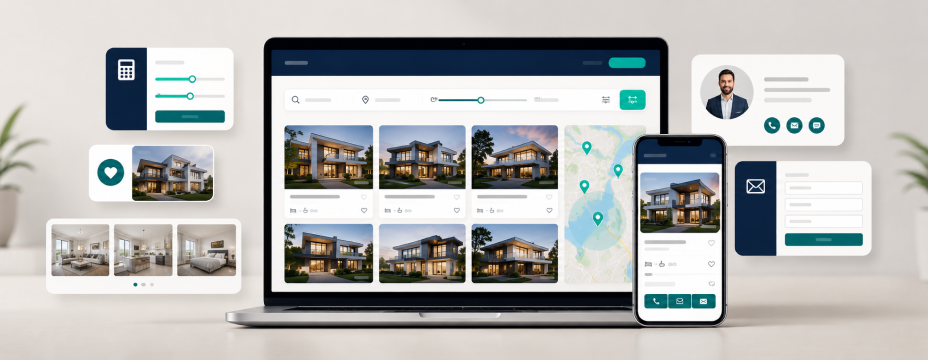
A property page is where a browser decides whether to call, so it needs a swipeable photo gallery, floor plan, price, location map, walkability score, mortgage estimate, and a contact form. The more a buyer can check there, the likelier they make contact. The WPResidence property page supports all of this, plus 360-degree tours and a price-on-application label.
A keyword box is not a search feature. Multi-filter search across price, type, bedrooms, school district, lot size, and amenities keeps buyers on your site. A family that cannot filter to "3-bed, under $500k, Jefferson School District" sees 800 irrelevant listings and leaves for a portal. Saved search with daily or weekly alerts turns that visitor into a recurring contact who sees your branding every morning. The search builder adds geo-radius search by distance and unlimited Elementor search bars.
A map answers the buyer's first location question before they call. The half-map layout (listings on one side, map on the other) has become a common layout for search results pages, used to gauge commute, schools, and neighborhood boundaries. The advanced map features include Google Maps and OpenStreetMap, pin clustering for large inventories, and satellite or hybrid views.
Before a buyer clicks into a listing, they scan the card: the thumbnail in search results. Card design controls what shows at a glance: price, beds and baths, square footage, status label (Active, Sold, Reduced), agent photo, and favorite buttons. Cards that hide too much get fewer clicks; cards that crowd in everything read cluttered. The property card composer offers 7 card designs and up to 5 custom fields each.
These three terms get conflated constantly, and the difference decides where your buyers search. The MLS (Multiple Listing Service) is a private, agent-only database, the source of record for active listings. IDX (Internet Data Exchange) pulls a subset of MLS data onto an agent's public website; it requires MLS membership plus a signed IDX agreement, and standalone plugins typically run $50 to $100-plus per month. Listing syndication pushes your listings out to Zillow, Realtor.com, and similar portals.
IDX brings search to your site; syndication takes your listings to someone else's. Both have a role, but IDX gives buyers a reason to register on your own domain. Real estate websites with IDX receive roughly four times as much traffic as those without, according to Luxury Presence internal data (a single vendor figure, not independently audited). WPResidence handles this through MLS import compatibility via the MLSImport.com integration, which connects to any RESO-ready U.S. or Canadian MLS for $49/month after a 30-day trial, one MLS per installation. Two caveats: MLS images load from the MLS CDN rather than importing, and not all MLS systems join IDX sharing, so confirm availability with your local board.
Three tools get confused here: the form that turns a visitor into a named contact, the system that manages that contact afterward, and the self-service area where the contact manages their own account.
Lead capture is the moment a browser becomes a named contact, and follow-up speed matters more than most agents think. Leads called within 5 minutes rather than 30 are 21 times more likely to qualify the lead (MIT Lead Response Management Study, Dr. James Oldroyd). The lead generation form deploys on property pages, agent profiles, sidebars, or pop-ups, with HubSpot routing.
A CRM is what happens after capture. It stores the contact, tracks interactions, and routes submissions so nothing sits forgotten in an inbox. It is conditional: a solo agent with fewer than five inquiries a week can manage by hand, while higher-volume teams need the automation. Built into the theme, the WPResidence CRM (WpEstate CRM) includes 27 automation rules, a visual deal pipeline, Twilio SMS, bidirectional HubSpot sync, and role-based access so agents see only their own records.
The dashboard is the self-service area for registered users, not the admin backend or the CRM. Buyers manage saved searches and favorites. Agents edit and track listings, and portal operators manage invoices. The advanced dashboard is a frontend (non-wp-admin) interface with My Properties, Favorites, Add New Property, Invoices, and per-listing view stats.
People pages matter for converting visitors because buyers still rely on people. The agent profile is where a buyer moves from browsing to contacting.
88% of home buyers completed the purchase through an agent (NAR 2024, attributed to Dr. Jessica Lautz, NAR Deputy Chief Economist), so agent credibility directly affects whether buyers make contact. An agent page needs a photo, bio, service areas and specialties, active listings, ratings and reviews, and a contact form. Pages missing this push buyers to Google the agent's name. The agent pages feature supports 4 card styles, ratings and reviews, and toggleable sections for specialties and service areas.
For brokerages and developers, brand pages carry the same weight as agent pages: buyers want to see who the firm is, which agents represent it, and which projects it has delivered. A developer project page adds floor plans, unit availability, and a downloadable brochure as reasons to leave contact details. The agencies and developer pages include team listings, an office map, reviews, and search by name or location.
Membership and paid listing systems exist for portal models, where the site charges agents, agencies, or private sellers to publish listings for a set period. The three modes are free (admin controls all listings), pay-per-listing (a one-time fee per post), and subscription (recurring, with quotas and featured slots). For a single agent or brokerage whose admin adds every listing, it adds complexity with no return. Payments run through PayPal, Stripe, Bank Transfer, or WooCommerce, though WooCommerce does not support recurring payments in WPResidence. The membership system customizes packages by user role, with expiry and auto-renewal.
Two of these three are conditional, and the third is universal but routinely misunderstood.
Multilingual matters for sites serving non-English speakers or cross-border markets: Miami serving Latin American buyers, Canadian French-English markets, Gulf-region investors. For a single-region domestic brokerage, it adds complexity without return. The multilingual support in WPResidence includes AI auto-translation via the OpenAI API, RTL-ready layouts, per-language canonical URLs and hreflang tags, and WPML, Polylang, and Weglot compatibility.
Multi-currency is a display feature, not a payment feature: visitors see prices in their local currency through a header dropdown, with rates updating automatically. It earns its place where cross-border inquiry is real (foreign buyer activity in U.S. luxury real estate jumped 44% year over year, per the Sotheby's International Realty Luxury Outlook (reported by Robb Report, 2026), a luxury-segment figure). A domestic single-market site does not need it. The multi-currency support is admin-controlled, so you choose which currencies show.
Responsive design and mobile-first design are not the same. A site built desktop-first can still deliver small tap targets, horizontal scroll on forms, and photos that will not swipe. For real estate, where most search traffic happens on phones, mobile-first is the baseline: swipeable galleries, agent info always visible, single-column forms, fast cellular load. It is an expectation, not an add-on plugin.
Each niche real estate website type demands a different audience focus, data schema, and proof of authority.
43% of buyers started their property search online and effectively all used the internet during their search (NAR 2024 Profile), making search, maps, and lead capture non-optional.
Seven real estate website features apply to every site. IDX, CRM, membership, multi-currency, and multilingual are conditional on business model and audience.
Leads called within 5 minutes are 21 times more likely to qualify (MIT Lead Response Management Study, Dr. James Oldroyd), so CRM notification speed is a revenue variable.
IDX brings MLS data to your domain; syndication sends listings to third-party portals. Both serve different goals and are not substitutes.
Every real estate website needs seven core features: property listings with a structured detail page, advanced filtered search, an interactive map, lead capture forms, agent profiles, saved searches with alerts, and mobile-first design. A WordPress real estate theme like WPResidence covers these at launch. Conditional features (IDX, a CRM, membership, multi-currency, multilingual) apply only to specific business models and audiences.
A CRM is conditional on lead volume. A solo agent with fewer than five inquiries a week can manage contacts manually. Once inquiries outgrow what email can track, CRM automation (routing, follow-up reminders, pipeline tracking) pays for itself. The value is response speed and follow-up consistency. WPResidence's built-in CRM (WpEstate CRM) handles routing, pipelines, and HubSpot sync.
IDX (Internet Data Exchange) is the framework that lets agents display a live feed of MLS listings on their own website. It requires active MLS membership and a signed IDX agreement with the local board. IDX is distinct from listing syndication, which sends your listings to Zillow, and from plain MLS membership, which is agent-only. WPResidence connects to IDX through the MLSImport.com integration.
A regular real estate website is any agent or brokerage site. An IDX website goes further: it connects to an MLS data feed and displays live listings from the broader MLS, not just the agent's own properties. That distinction matters, because an IDX website gives buyers a reason to search, register, and return. WPResidence supports both.
Once your feature scope is clear, the next decisions are visual: layout and template. The principles of real estate website design cover layout and UX, while real estate website templates give you pre-built starting points. Both determine how well the real estate website features reach buyers.