
Best Luxury Real Estate Websites in 2026
Last updated: May 31, 2026
The best luxury real estate websites are not defined by price point. They deliver three things at once: visual confidence that signals the tier of the properties, content depth that earns search rank, and a conversion path that turns a browser into a conversation. Real-estate marketing data compiled by MarketingLTB shows that 43% of buyers begin their home search online, and 69% use a mobile phone or tablet to view listings, so even a cinematic site has a hard performance floor to clear. This is not a gallery of pretty screens. It is an annotated critique of 10 standout high-end real estate websites, each broken down by what it nails, one thing worth stealing, and what we would watch. Jade Mills Estates, Sotheby’s, and Vide Infra’s “Ever” all make the cut.
How We Chose These 10 Sites
Every list claims to feature “the best,” and almost none explain how. We judged each site on four dimensions: visual excellence (does the design signal the price point?), brand storytelling (does it communicate who the agent is?), search and IDX architecture (neighborhood depth, market reports, ranking content), and conversion engineering (off-market access, CTA clarity, lead pathways).
Each of the 10 URLs was verified live in 2026. The mix is deliberate: individual agents, teams, boutique brokerages, one global brokerage, and an award-winning development site. Market specialization shapes everything, and agents serving niche real estate websites often show the strongest brand clarity. As Tom Ferry puts it, “If your marketing does not look like luxury, it will not attract luxury.”
Here are the 10 sites featured in this guide:
- Vide Infra “Ever”
- Jade Mills Estates
- Kumara Wilcoxon
- Saslove & Warwick
- Carolwood Estates
- Breitenbach Advisory
- Ginger Martin
- Ben Belack Group
- Sotheby’s International Realty
- Village Properties
Vide Infra “Ever”
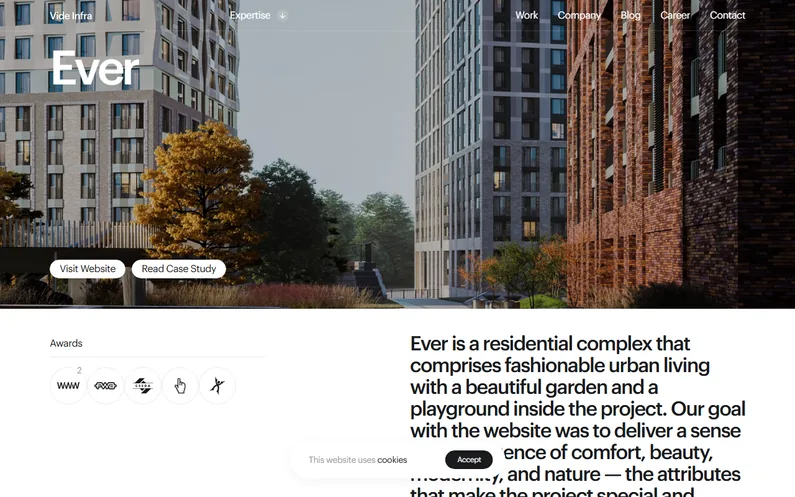
We open with the highest design ceiling on the list. “Ever”, built by the Ljubljana agency Vide Infra, won Awwwards, CSSDA, and FWA Site of the Day simultaneously in August 2023, a triple crown documented on its own blog. The site uses WebGL 3D visualizations and animations as narrative devices. It is a development marketing project, not an agent platform.
What it nails
Experience as narrative: every scroll tells the property’s story rather than displaying data, and the three awards are third-party proof that press can cite.
What to steal
Treat design awards as PR assets. An Awwwards or CSSDA win is a citable credential that outlives the launch cycle.
What we’d watch
WebGL intensity creates mobile performance risk, and award criteria do not measure lead generation. Treat this as inspiration for development marketing, not an agent-site template.
Jade Mills Estates
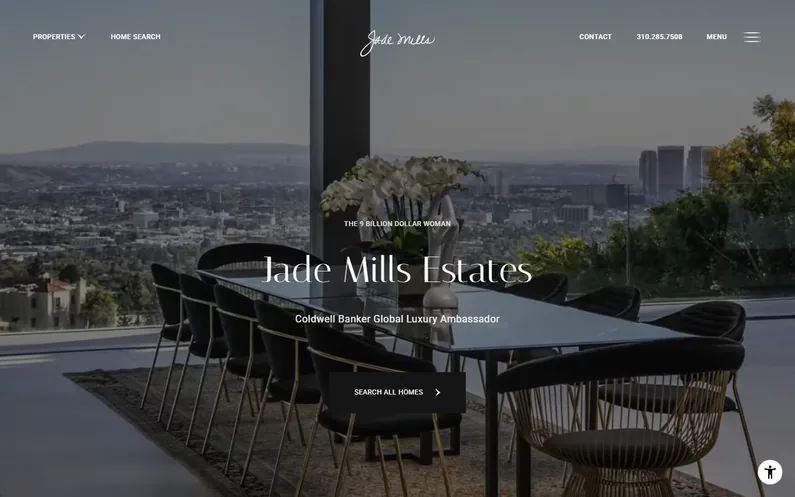
The most credentialed site here leads the individual-agent section. Jade Mills Estates belongs to Jade Mills, who has logged more than $9 billion in career sales, ranks as Coldwell Banker’s #1 agent worldwide, and sits in the Inman Golden I Hall of Fame, all stated on her site. Mills credits it directly: “My clients are always telling me that they found me from my website.” And the restrained luxury real estate design (no video hero, no animation) still ranks #1 on Google for multiple Beverly Hills keywords.
Where it excels
Neighborhood guide architecture: each area page (Beverly Hills, Bel Air, Malibu, Holmby Hills) fuses an IDX feed with lifestyle editorial, creating SEO landing pages that compete with Zillow for hyper-local queries.
Steal this
The “one neighborhood, one page, one story” structure. Build dedicated area pages that combine search data with editorial copy; the compounding SEO effect is real.
The tradeoff
The hero relies on static photography; a subtle video loop could strengthen first impressions for agents competing on cinematic appeal.
Kumara Wilcoxon
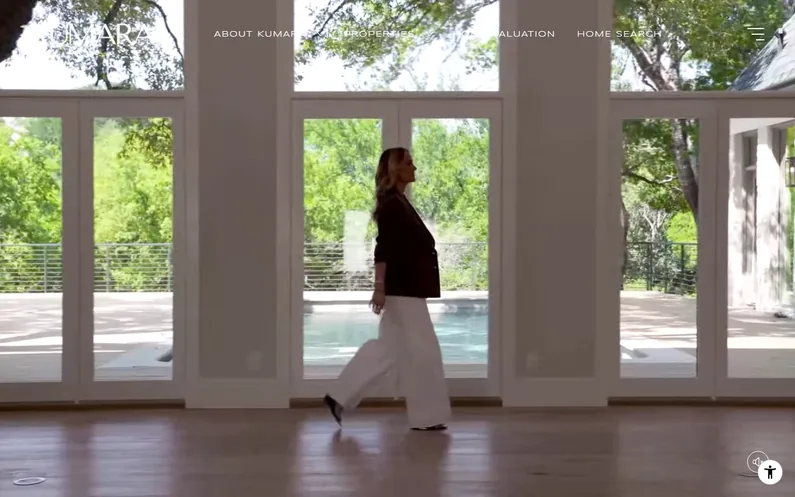
Where Jade Mills runs cool, Kumara Wilcoxon runs warm. The Austin agent, with more than $2.5 billion in sales under Sotheby’s International Realty, uses cream, soft gold, and warm brown, the textbook “quiet luxury” palette that signals refinement through restraint rather than ornament. Video runs throughout, the default search carries a hardcoded $1M-plus minimum filter, and a “Bespoke Marketing” page spells out how listings get marketed.
What works
The warm palette reads as inviting without giving up luxury signaling, proof that quiet luxury’s earth tones build HNW trust as well as gold-and-black.
The takeaway
The “Bespoke Marketing” page: showing sellers exactly how their home will be marketed is a strong listing-lead mechanism almost no agent sites use (which is exactly why it converts).
Worth watching
Heavy video across multiple pages creates mobile performance risk, so the trade-off with Core Web Vitals needs monitoring.
Saslove & Warwick
Saslove & Warwick shows market authority as a content strategy. The Aspen team brings 60-plus years of combined experience and more than $5 billion in closed sales, and ranks as the #1 team in Aspen, per their site, which publishes a live Q1 2026 market report. So the team publishes like a media operation: a Market Reports section with quarterly archives from 2023 through 2026, a standalone Videos item, and a personalized search portal.

The standout
Quarterly market reports as owned content: a recurring reason for past clients to return and for press to cite the team.
Worth borrowing
A dedicated “Market Reports” archive: one recurring investment that doubles as a press asset, an SEO signal, and a retention touchpoint.
One caveat
The navigation carries a lot of items; on mobile, a simpler menu could reduce decision fatigue for first-time visitors.
Carolwood Estates
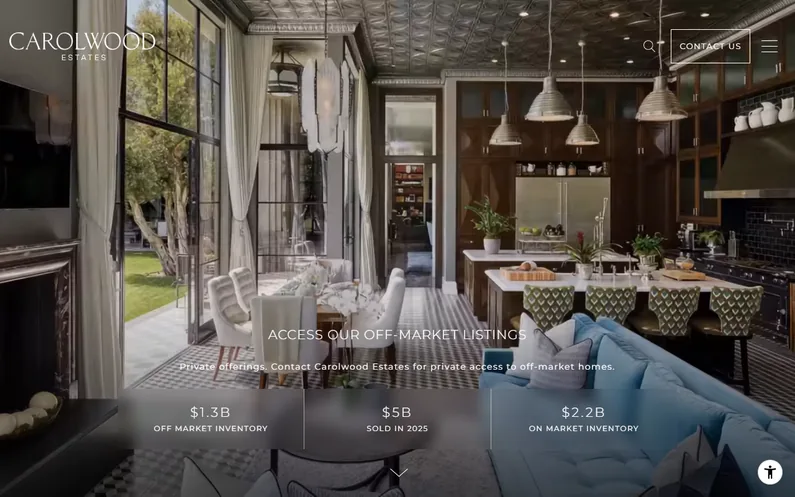
Carolwood Estates is the clearest data-backed case here. A Luxury Presence case study reports that the boutique Beverly Hills brokerage drew 2,200 monthly Google visitors, indexed 887 keywords, and landed 71 of them on page one within four months of launch (treat those figures as a vendor-cited illustration). The site gates an “Off Market” section behind agent contact, displays Forbes Global Properties and Knight Frank logos, and runs full-screen listing imagery.
Why it works
Off-market access as lead capture. Gating off-market inventory behind an agent conversation creates an intent-qualified conversion point; buyers who click are serious.
The one move
Third-party network logos in the navigation: Forbes Global Properties and Knight Frank marks signal reach to international buyers instantly, without a word of copy.
The risk
But the SEO numbers come from a single vendor case study, so independent verification would strengthen them, even if the result is plausible.
Breitenbach Advisory
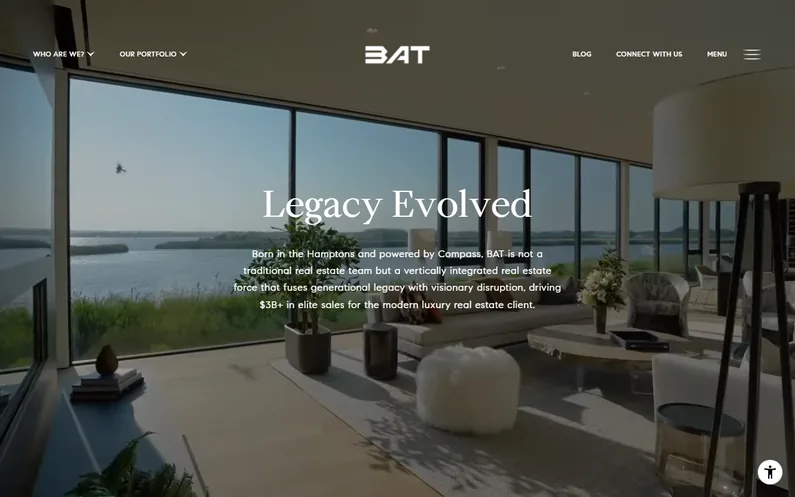
Breitenbach Advisory carries the most unusual differentiator in the set. Matt Breitenbach, a born-and-raised Hamptons agent with Compass and more than $3 billion in elite sales (per his site), runs a proprietary in-house content engine called “Disrupt Media,” complete with the “BAT Disrupt Podcast.” The navigation segments by Hamptons sub-market, and “The Breitenbach Advantage” lays out the team’s philosophy.
What it nails
The branded media studio. With enough local-market video and podcast content, the website becomes a media destination with its own audience, not just a listings portal.
Worth borrowing
The philosophy section. Articulating why a buyer should choose this agent converts curious visitors into prospects before a single call.
Worth watching
A media-heavy site has to maintain cadence. If the podcast or video output pauses, the advantage erodes with it.
Ginger Martin
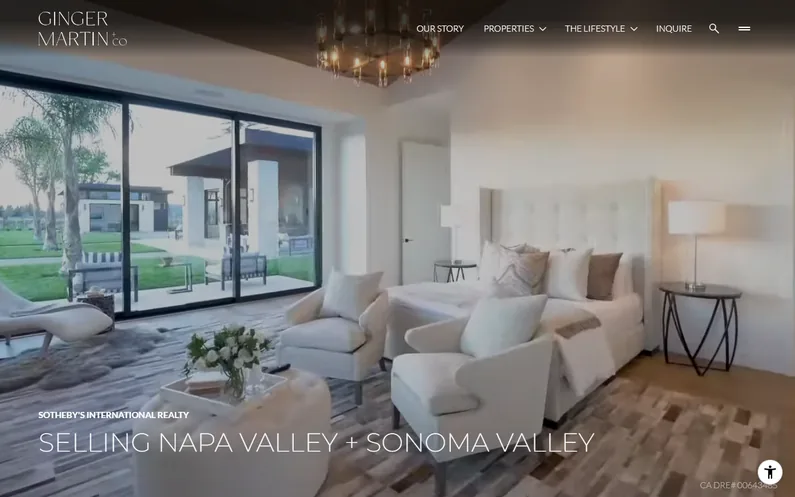
Ginger Martin is the lifestyle-niche specialist. A Wall Street Journal Top 250 agent and Sotheby’s founding San Francisco associate with more than $3 billion in all-time sales (per her site), Martin built the site as a Napa Valley wine-country destination, not a generic real estate site. A Napa lifestyle editorial blog anchors the content, a sub-agent roster appears, and a Global Collective membership is displayed.
Where it excels
Wine-country lifestyle framing. The site is the Napa and Sonoma destination, sticky for UHNW buyers who are lifestyle-first and price-second.
Steal this
A lifestyle editorial blog tied to one geography creates content depth, SEO territory, and an emotional hook listing pages cannot match.
The risk
But several sub-agent names without a clear hierarchy can dilute the lead agent’s brand for new visitors.
Ben Belack Group
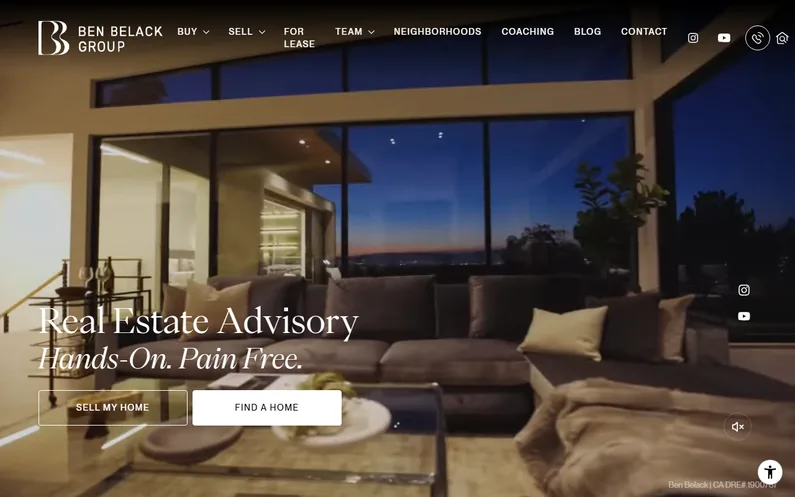
Ben Belack Group shows how a media-profile agent converts recognition into architecture. Belack, of Netflix’s “Buying Beverly Hills” and now with SERHANT. in Beverly Hills (per his site), splits the homepage by intent with “Buy With Us” and “Sell With Us” navigation. Buyer and seller resources sit in distinct areas, a Press section runs prominently, and the sold portfolio is named “Past Successes.”
What works
“Past Successes” as a navigation anchor. Renaming the sold portfolio turns closed transactions into active proof; every past sale becomes a trust signal, not a dead listing.
What to steal
Bi-directional navigation. Splitting the homepage journey by visitor intent routes each visitor to the content most likely to convert.
One caveat
Leaning on a celebrity profile creates a dependency. As the show ages, the narrative will need to evolve beyond Netflix.
Sotheby’s International Realty
The sole major-brand entry shows what global luxury web design looks like with institutional resources behind it. Sotheby’s International Realty runs an editorial-style design with a proprietary “shop-the-room” feature that overlays furniture on listing photos, plus multi-language and multi-currency display at global scale and 3D virtual reality. The 3D-tour emphasis ties to real performance: a Matterport analysis of MLS data found listings with 3D tours sell up to 31% faster in some regional markets.
The standout
“Shop the room.” Overlaying furniture and decor on listing images turns a listing into an aspirational experience rather than a data transaction.
The takeaway
Localization at scale. For agents targeting international HNW buyers, multi-currency display and human translation is a trust signal individuals rarely match.
What we’d watch
But at institutional scale, the site serves the brand as much as any agent. Solo agents cannot replicate the investment, so treat it as directional.
Village Properties
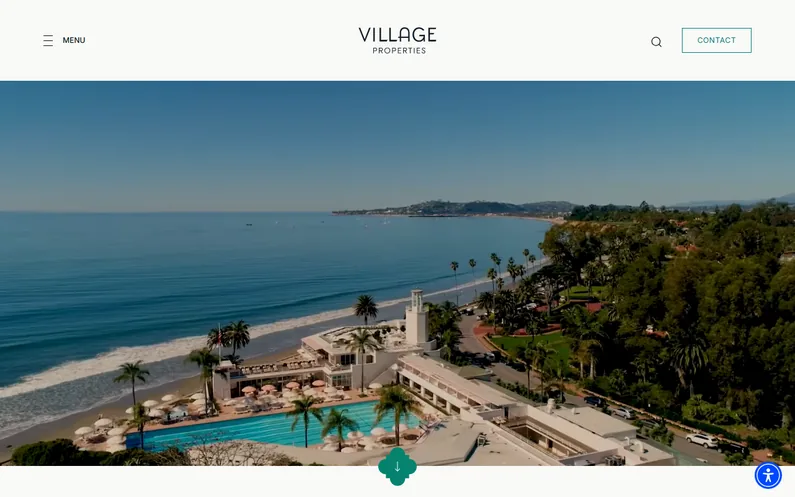
We close on the simplest idea on the list. Village Properties, a Santa Barbara boutique brokerage with more than $20 billion in represented sales (per the Luxury Presence portfolio), builds its hero around “window-like imagery” that gives a literal glimpse into a property.
Why it works
The “window frame” hero. Treating the browser as a window into the property, not a gallery, makes any hero feel architectural.
The one move
Brief the photographer to shoot “through” negative space (doorways, windows, thresholds) rather than head-on, so the browser becomes a frame, not a canvas.
The tradeoff
A brokerage site serves multiple agents; solo agents should make the hero reflect personal brand, not just inventory.
What the Best Luxury Real Estate Websites Have in Common
Five patterns run across all 10 sites. Restraint beats ornament. Warm, restrained palettes (beiges, deep olives, charcoals) dominate every top individual-agent site here, a visible shift from the gold-and-black maximalism of the prior cycle. As DMR Media’s Andrew Rohm writes, “exclusivity is communicated through restraint rather than excess. When your design mirrors the refinement of the properties you represent, you establish immediate authority.”
Content depth is the SEO moat. Neighborhood pages, market reports, and lifestyle editorial are the structure that earns rank, the same that put 71 of Carolwood’s keywords on page one in four months.
Performance is non-negotiable. With 69% of buyers viewing listings on mobile (MarketingLTB), an ambitious luxury property site that loads slowly gets abandoned no matter how it looks on desktop. Core Web Vitals are the invisible floor under every site here.
Every site has one hard conversion point: a gated CTA, off-market access, or a Bespoke Marketing inquiry forcing an agent conversation, not passive browsing.
AI discoverability matters now. Tiffany Pantozzi of Align Real Estate told Inman in December 2025, “I got my first listing from somebody asking ChatGPT who one of the best agents was. I came up on a short list and he called.” So structured content now feeds Google and AI search.
A few strong sites sit just outside this list for scope reasons, not quality. Carlin Wright (carlinwright.com) runs a distinctive black-and-white editorial aesthetic out of New York City. Danielle Lazier (daniellelazier.com) uses a minimalist single-scroll in San Diego, Top Agent Network verified. Global Collective (globalcollective.com) leans on network branding behind tens of billions in sales. We left them out to avoid duplicating markets already covered.
Key Takeaways
- 43% of buyers begin their home search online and 69% view listings on mobile (MarketingLTB), making website quality a direct revenue variable, not a branding luxury.
- Neighborhood pages that pair an IDX feed with lifestyle editorial are the pattern that lets a luxury site out-rank Zillow for hyper-local queries.
- The quiet-luxury palette of warm beiges, deep olives, and charcoals has displaced gold-and-black maximalism across every top individual-agent site reviewed here.
- Listings with 3D virtual tours sell up to 31% faster in some regional markets, per Matterport’s MLS analysis, so immersive media is more than an aesthetic choice.
- Off-market gating, Bespoke Marketing pages, and quarterly market reports are the conversion and retention features separating the best sites from galleries.
Frequently Asked Questions
What makes a luxury real estate website different from a regular one?
Not the price point, but the simultaneous delivery of three things: visual confidence that signals the property tier, content depth such as neighborhood pages and market reports, and conversion architecture like gated CTAs and off-market access. Andrew Rohm frames it as authority through restraint. With 69% of buyers viewing listings on mobile (MarketingLTB), fast mobile performance is a baseline every luxury real estate website must clear.
How many pages should a luxury real estate website have?
There is no fixed number, but the best sites share an architecture: one page per neighborhood, a listings section with IDX, an about section with credentials, and a market-reports or press section. Sparser sites such as Ginger Martin and Village Properties prove a well-edited 10 to 15 page site beats a sprawling one that lacks depth per page.
Should a luxury agent use a platform like Luxury Presence or build a custom site?
Platform builds deliver faster SEO launch, pre-built IDX, and proven design standards; Carolwood’s 71 page-one keywords in four months is illustrative. Custom builds like Vide Infra’s “Ever” reach higher design ceilings but cost agency-level money and ship no IDX. The choice turns on budget and whether you prioritize lead generation or prestige. As Tiffany Pantozzi warned in Inman, verify you own the code and content either way.
What does a luxury real estate website cost to build?
Costs vary widely by scope and market, and there is no single honest number. Subscription platform builds sit far below the cost of a bespoke design-agency project, which is why most working agents start there. A custom, award-caliber build runs considerably more because it is essentially a creative-agency engagement. Scope it against your lead goals first, then price it.
What separates the best luxury real estate websites from the rest is not any single feature; it is the discipline of pairing visual confidence with functional performance on the same site. The build decisions behind a site like this are covered in our guide on how to build a luxury real estate website. Working examples of brand and design choices sit in the clients showcase.