Best Commercial Real Estate Websites in 2026
Last updated: May 31, 2026
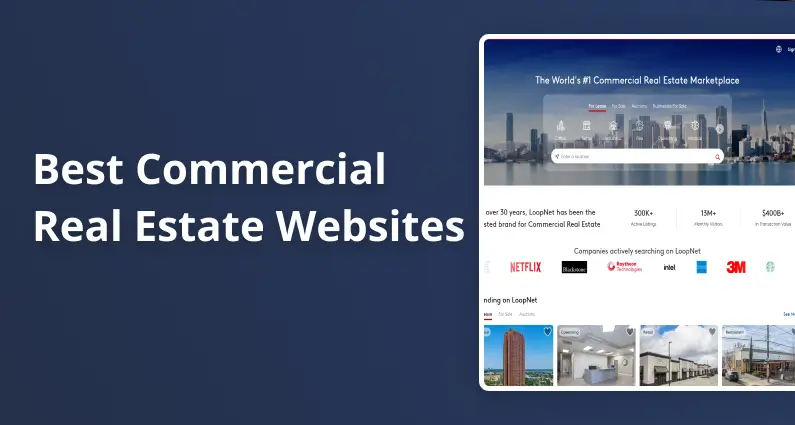
The best commercial real estate websites do one of two jobs, and serious operators use both. The first is marketplace discovery: LoopNet, Crexi, and CommercialEdge are where buyers and tenants search public inventory. The second is owning your brand and lead pipeline through your firm’s own commercial property website. LoopNet draws more than 12 million monthly visitors, per industry traffic estimates. Crexi topped $815.6 billion in active sale listings through November 2025, per Crexi’s PR Newswire release. CommercialEdge carries 10 million-plus property records on Yardi’s network. None of those platforms substitutes for a branded website you control, where every lead, every data field, and every listing stays yours. For the broader category map, see our guide to niche real estate websites.
This guide covers the major listing websites, the firm sites worth studying, and the data model your own site needs.
What Makes a CRE Website Different from a Residential One
A commercial real estate website is a platform built to surface CRE-specific data (cap rate, NOI, lease type, building class, and square footage ranges) that no residential MLS or IDX system carries. Where residential platforms run on bedrooms, bathrooms, and school districts, a CRE site has to expose net operating income, NNN versus gross lease structure, building class (A, B, or C), clear height, and availability by floor or suite. A buyer filtering for a 20,000-square-foot dock-high warehouse needs every one of those commercial fields and none of the residential ones.
There’s a structural reason for the gap. Capstone Commercial explains that the absence of an MLS for commercial listings reflects how the industry works. A smaller buyer pool, specialized property types, and broader reach mean brokers lean on relationships and specialized platforms. Residential MLS is regional and mandated for REALTOR members. CRE listing is voluntary and national.
The building class shorthand comes from BOMA. Class A means the highest-quality space at above-market rents. Class B covers average rents with adequate systems. Class C is functional space at below-average rents. Residential IDX serves residential brokers well; it was never built to carry any of this.
The Major CRE Listing Platforms
These are the commercial real estate listing websites where public inventory surfaces. Each is strong at something specific, and the table maps where each fits before the breakdowns.
| Platform | Asset Focus | Scale / Reach | Known For |
|---|---|---|---|
| LoopNet | All CRE types | 12M+ monthly visitors; 1.1M listings; 5.1B SF for lease | Traffic volume; CoStar data integration; tiered visibility |
| Crexi | All CRE types + auctions | $815.6B active listings (Nov. 2025); 2M+ MAU | Full transaction workflow; cap rate & NOI filters; auction platform |
| CommercialEdge / CommercialCafe | Office, industrial, retail | 10M+ property records; 2M+ monthly visits | Yardi data network; free broker syndication; SEO distribution |
| Brevitas | Investment & off-market | 45,000+ CRE professionals | Private listings; Deal Rooms for due diligence; 1031-friendly tools |
| Catylist / CommercialExchange | All CRE types (regional CIEs) | 70+ REALTOR associations; 50+ CIEs | NAR-affiliated regional network; closest analog to a CRE MLS |
| Ten-X | Investment sales, distressed | Part of CoStar/LoopNet | Online auction; sub-100-day close; percentage-based buyer fee |
LoopNet owns the traffic moat. As a CoStar subsidiary, it draws more than 12 million monthly visitors, per industry traffic estimates. Its 1.1 million listings and 5.1 billion square feet for lease are per SharpLaunch’s 2026 guide. The honest tradeoff is tiered visibility: a free listing gets minimal exposure while premium tiers dominate results. Its LoopLink embed lets independent brokers surface that inventory on their own site.
Crexi is the fastest-growing of the LoopNet alternatives. Its December 2025 PR Newswire release reported $815.6 billion in active sale listings through November, up 16.7% year over year, with 2 million-plus monthly active users and lease transactions up 22.7%. Founder and CEO Michael DeGiorgio framed it: “The pace of CRE deals today isn’t just set by the market. It’s also shaped by the tools people are using.” Crexi Intelligence layers in cap rate comps and historic NOI, making it meaningful for investment buyers, not just browsers.
CommercialEdge and CommercialCafe run on Yardi’s network. SharpLaunch’s 2026 guide puts the network at 10 million-plus property records, 2 million-plus monthly visits, and more than 350,000 broker contacts a year. Brokers syndicate free, with a paid research tier at $250 per month (or $2,400 per year) for comps. The real draw is SEO: first-page Google rankings across top markets send organic buyers to listings brokers never paid to promote.
Brevitas takes the opposite approach. Its NAR profile lists 45,000-plus CRE professionals, and the membership gate keeps the audience qualified rather than mass-market. Deal Rooms give buyers a secure due-diligence workflow, and 1031-friendly tools target investment-sales activity. Founded in 2015, it leans private and off-market.
Catylist and CommercialExchange are NAR-affiliated, powering 70-plus REALTOR associations and 50-plus Commercial Information Exchanges, per Catylist’s own platform description. That regional network is the closest thing CRE has to an MLS, and it works well where local participation is strong; outside those markets, coverage gets patchy. Moody’s Analytics acquired Catylist, introducing some uncertainty about direction.
Ten-X is the CoStar and LoopNet auction arm. It runs three formats (Live Bid, Managed Bid, and Offer Select), with most assets listing to close in under 100 days and a published buyer transaction fee set as a percentage of the winning offer, per CoStar’s Ten-X platform documentation. The time-bound bid creates urgency that a standard “contact broker” page can’t replicate.
Reonomy, CoStar, and CIMLS get cited constantly in CRE content, but none belongs in a listing-platform comparison for independent brokers. Reonomy (now under Altus Group) is a property-intelligence tool with 54 million-plus records and LLC unmasking, built for off-market sourcing rather than marketing listings. CoStar is the institutional subscription standard at roughly $1,000 to $10,000-plus per month, impractical for independent brokers. CIMLS has offered free listings since 1999 but carries limited traffic next to the platforms above.
Standout Brokerage and Firm Websites Worth Studying
The marketplaces show where deals surface. The national brokerage sites show what your own commercial real estate website design should aspire to. Three are worth a close read.
CBRE
CBRE’s site works as an authority engine first and a listing engine second. Its Insights and Research hub draws on more than 500 researchers across 250-plus markets, per CBRE’s research services overview, and property search sits behind that research. The lesson for an independent firm: publish a recurring market report. Even a one-page quarterly PDF builds authority a listings-only site never can.
JLL
JLL pairs its property search with a deep research and insights library, covering market outlooks, capital-flows analysis, and sector trend reports that give a listing its analytical backdrop. The takeaway is structural: publish market context alongside your listings so a property arrives with the analysis behind it, not as a bare address. A broker who specializes in industrial flex should signal that focus through the research they put forward.
Marcus & Millichap
Marcus & Millichap leads with investment-sales positioning and quantified proof. Its services page states the firm closes a transaction “every 13 minutes of every single business day,” and a sticky “Connect With an Advisor” call-to-action follows the visitor down the page. The borrowable move: quantify deal volume on the homepage, where a concrete metric beats firm history.
The CRE Data Patterns That Separate Good Sites from Generic Ones
What separates a real commercial property website from a generic property search isn’t the design. It’s the data model underneath the search form. Six data patterns show up on every effective CRE site:
- Square footage range search: rentable and usable SF shown separately, with a min-to-max range slider rather than a single number.
- Cap rate and NOI display: investment listings without a cap rate are incomplete; the Cauble Group’s 2026 ranges run from Multifamily Class A at 4.5-6.0% to Industrial big-box at 5.5-7.0% to Class B office at 8.5-11%.
- Lease type filter: NNN (tenant pays taxes, insurance, and CAM), Modified Gross, and Full Service as a required dropdown, not an afterthought.
- Building class taxonomy: Class A, B, and C per BOMA, with the caveat that class is market-relative; a Class A in a tertiary market is not a Class A in Manhattan.
- Industrial specs: Clear height (32-40 ft for modern distribution, where the WareCRE guide notes each added foot adds 7-10% storage capacity), dock-high door count, and truck court depth.
- Availability by floor or suite: multi-tenant buildings need a stacking plan or matrix, not just one total square-footage figure.
Each asset type leans on its own subset. Office listings need building class, floor-by-floor availability, parking ratio, and lease type. Industrial and flex listings need clear height, loading docks, power in amps, and column spacing. Retail lives on anchor tenant, traffic counts, co-tenancy, and NAICS code. Investment and multifamily turn on cap rate, NOI, price per unit, occupancy, and rent roll.
Strip those fields out and the search page returns results no buyer can qualify quickly.
Why Residential Website Templates Fall Short for CRE
The mismatch is structural, not cosmetic. As Capstone Commercial lays out, residential IDX and MLS are regional, mandated for REALTOR members, and carry bedroom, bathroom, and HOA data. CRE listing is voluntary, national, and runs on cap rate, NOI, NNN lease type, building class, and clear height.
So a residential IDX connector pulls no cap rate, no NOI, no lease type, no building class, and no clear height. A residential theme used for CRE isn’t “close enough,” because the search functionality the buyer needs doesn’t exist in the data model.
This isn’t a knock on residential tools. Residential templates do excellent work for residential brokers; the issue is category, not quality. Agents who handle both need separate infrastructure for each. Property management sits in its own adjacent space, covered in our guide to the right property management website template.
How to Build a CRE Website on WordPress
The CRE data model in WordPress
A purpose-built property listing WordPress theme handles property post types, search templates, and map integration out of the box. Generic page builders used alone (Elementor, Divi) make you add custom post types from scratch.
What matters long term is whether custom fields survive theme updates or sit baked into the theme core. A field architecture that holds through updates separates a theme that serves CRE for years from one that breaks your data model on the next patch.
Custom fields for CRE data
This is where WPResidence fits the CRE use case. Its custom fields builder is point-and-click in the admin, supports unlimited fields, survives theme updates, and wires each field into search. You can map the CRE model directly: Cap Rate (numeric, percentage), NOI (numeric, dollars), Clear Height (numeric, feet), Loading Docks (numeric), Lease Type (dropdown of NNN, Modified Gross, Full Service), Building Class (dropdown of A, B, C), Zoning (text), and Parking Ratio (numeric).
WPResidence fits independent CRE brokers who need custom fields that survive updates. Per its ThemeForest listing, it has 32,470 sales, a 4.85 out of 5 rating from 1,644 reviews per its structured data, was last updated May 20, 2026, and is priced at $79.
Search configuration for CRE
The WPResidence search builder handles tabbed search forms, so a Commercial tab and a Residential tab can live side by side, with range sliders for numeric fields (cap rate at or above X percent, SF between Y and Z), comparison operators, and map or half-map display modes. Availability by suite runs through a subunit architecture. The tabbed setup separates commercial and residential inventory without two WordPress installs, practical for mixed-portfolio brokers.
Honest limitations
A few constraints matter before you commit. WPResidence has no built-in syndication to LoopNet, Crexi, or CommercialEdge, so you dual-post manually or add a third-party tool. It has no CoStar or national data integration; the site shows only what you enter or import. Per its ThemeForest listing, WooCommerce recurring payments are “not supported by WooCommerce,” which matters for membership models. And theme support excludes custom development, so a complex CRE data model can still need a developer.
Choosing Among the Best Commercial Real Estate Websites for Your Situation
This is a decision matrix, not a ranking. Four scenarios cover most CRE professionals:
- National reach, maximum exposure: a LoopNet premium tier plus a Crexi listing, with per-listing fees as the cost of distribution.
- Off-market or investment-grade deals: Brevitas for private listings, Crexi Intelligence for comps.
- Regional, NAR-member broker: the Catylist or CommercialExchange CIE in your market.
- Independent or boutique brokerage building a brand: your own WordPress site (WPResidence with custom fields and search builder) as the brand and data layer, plus marketplace listings for reach.
The last two aren’t mutually exclusive: most independent brokers run both, their own site for brand and data control and a platform listing for reach.
Key Takeaways
- LoopNet draws 12M+ monthly visitors (industry traffic estimates), and paid listing tiers are required for meaningful exposure.
- Crexi reached $815.6 billion in active sale listings through November 2025, up 16.7% year over year (PR Newswire, December 2025).
- Residential IDX and MLS data contains no cap rate, NOI, lease type, or building class, so the data model cannot serve CRE search.
- The six CRE data patterns every effective site needs: SF range, cap rate/NOI, lease type, building class, industrial specs, and floor-level availability.
- Independent CRE firms get the most from pairing a platform listing for reach with a branded own site for data control and lead pipeline.
Frequently Asked Questions
What is the best website for commercial real estate listings?
LoopNet leads on traffic, with more than 12 million monthly visitors per industry traffic estimates. Crexi is the fastest-growing alternative, with $815.6 billion in active listings and a built-in transaction workflow. Brevitas and the CommercialEdge network suit off-market and investment-grade deals. The right fit depends on asset type, market, and goal.
Why can’t commercial real estate listings use MLS or IDX?
Residential MLS systems are regional, mandated for REALTOR members, and carry bedroom, bathroom, and HOA data. As Capstone Commercial explains, CRE has no equivalent mandate: listing is voluntary, and the data model runs on cap rate, NOI, NNN lease type, building class, and clear height. An IDX connector pulls residential data with none of those fields, so it cannot serve CRE search.
How do I build a commercial real estate website on WordPress?
Use a purpose-built real estate theme with a custom fields builder, not a generic page builder. The theme supplies property post types, search templates, and map integration; the custom fields layer adds CRE data like cap rate, NOI, lease type, building class, and clear height without breaking on updates. WPResidence (32,470 ThemeForest sales, $79, last updated May 2026) supports tabbed commercial and residential search forms with range sliders.
What data fields should a commercial real estate listing include?
At minimum: square footage (rentable and usable), lease type (NNN, modified gross, or full service), asking price or rent per SF, and building class (A, B, or C). Investment listings also need cap rate, NOI, and occupancy; industrial properties require clear height and loading dock count; multi-tenant buildings need availability by floor or suite. Without them, a commercial property website returns results buyers cannot qualify quickly.
A marketplace listing and your own site are not competing choices. Platforms like LoopNet and Crexi deliver reach no single firm can match, while a branded site gives you data control and a lead pipeline that outlasts any per-listing fee. The best commercial real estate websites pair both, and the site you own should mirror what serious buyers search for: cap rate, NOI, lease type, building class, and availability by suite.
Related reading: